Bloodhounds are world-famous for their tracking abilities. They are commonly dubbed sleuth hounds or St. Hubert Hounds, which ties into their origin story.
However, these scent hounds are quite docile. They aren’t particularly active, though they are extremely relentless and stubborn when on a scent.
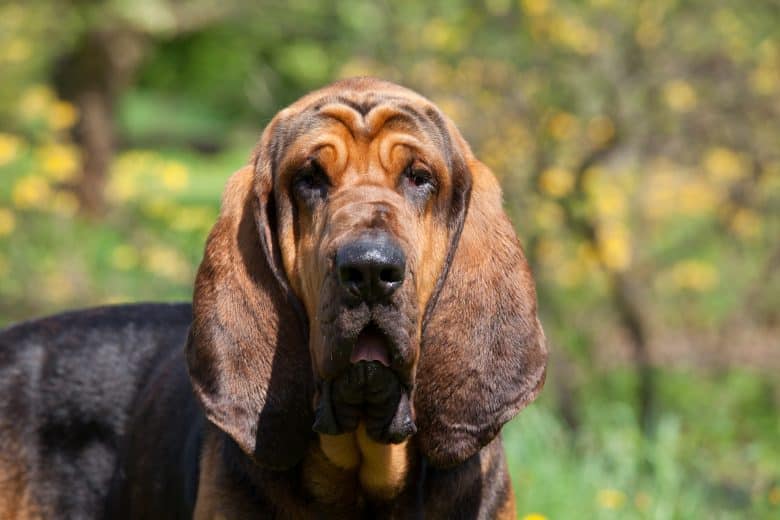
Wondering if one of these canines may be a good fit for your family? In this article, we’ll discuss everything you need to know about these determined hounds.
Where did the Bloodhound originate?
The origin of the Bloodhound is debatable. This is an old breed, and there are a few legends surrounding where exactly Bloodhounds came from.
One such legend describes these dogs being first bred at the Saint-Hubert Monastery in Belgium around 1000 AD. However, a more likely story is that these dogs came from France.
They may be related to several other French hound breeds, such as the Ariegeois. For a while, the dog was likely a mixed breed and not a set breed.
However, as centuries progressed, the canine eventually developed its own recognizable type and became the canine we know and love today.
While we don’t know exactly where the Bloodhound originated, we know that it was likely known throughout much of the ancient world during the middle ages, including England. They were taken to England in 1066 when William the Conqueror invaded.
A third-century scholar named Aelian likely described the Bloodhound in his book Historia Animalium. In this guide to animals, he mentions a hound with unrivaled scenting powers. This may very well be the Bloodhound.
While the breed has probably been around in some form for a very long time, it was perfected by high-ranking members of the pre-Reformation church.
Many churches and monasteries maintained packs of hounds on the church’s grounds. Monks often carefully bred the dog.
This may be why the hound became “blooded”. In other words, they are “of aristocratic blood”.
Since these early days, the Bloodhound has earned a reputation as one of the best tracking dogs around.
They are used by law enforcement to trail people of all sorts and are often used as cadaver dogs. They are even utilized in Africa to track poachers and in some search and rescue situations.
Often, these dogs track for hours. They could be on a trail for many days. However, their endurance to top-notch when it comes to following these trails.
This breed is recognized by most major kennel clubs, including the American Kennel Club. They have been a breed for a very long time.
What does a Bloodhound dog look like?

The Bloodhound looks like a dog designed to hunt by scent and shares characteristics with many other hounds.
They are very powerfully built and are quite tall – especially for a dog that was bred to have his nose in the dirt.
Their loose skin is quite thin to the touch and hangs in some areas, like around his head and neck. Deep folds are common due to this saggy skin.
The breed standard describes their head is quite narrow and long. It is also longer when compared to the rest of the body.
They have a fairly long snout that tapers evenly on both sides. The muzzle is about 12” long in most male dogs, while females’ muzzles are usually around 11” long. They do tend to be droolers.
They have deep-set eyes, which makes their “eyebrows” stand out. The eyes are usually diamond-shaped and may vary from hazel to yellow. Hazel is preferred for conformation, but yellow is okay as well.
Their long ears are very floppy and soft. They are quite thin when compared to the ears of other species. The ears usually fall in gentle folds, with the lower parts curling inwards. They usually have pretty healthy teeth.
These hound dogs have an extremely long neck that is well-muscled.
This helps them stay on the scent easier, which requires that they lower their head quite a bit towards the ground. The long neck helps with this. The chests form a deep kneel, and their back is heavily muscled.
Overall, they have a very muscular build with many of the usual hound characteristics. It is undeniable that they are made to hunt by scent.
Size: How big is a full-grown Bloodhound?

Male Bloodhounds are significantly bigger than female bloodhounds. Male Bloodhounds typically weigh about 90 to 110 pounds (40.8 to 49.9 kg) and stand at about 25 to 27 inches (63.5 to 68.58 cm).
On the other hand, females are a bit smaller. They typically weigh about 80 to 100 pounds (36.3 to 45.4 kg). They stand a bit shorter at around 23 to 25 inches (58.4 to 63.5 cm).
Bloodhounds usually achieve most of their weight at about 8 months. Most of their growth happens around 4-8 months. However, Bloodhounds may keep putting on more muscle until they are around two years old.
While Bloodhounds are quite large, they don’t need that much room. They can be well-mannered in an apartment if given plenty of exercises and have their needs otherwise met.
What type of coat do Bloodhounds have?
Bloodhounds come in a few different color combinations: black and tan, liver and tan, and red. Liver and tan dogs tend to have lighter colored eyes and are rarer. The black and tan variation is the most common and most recognizable.
The darker colors are usually interspersed with lighter hairs and can sometimes be flacked with white. These dogs may also have a bit of white on their chest and feet.
They have short fur that is hard and thick. They do not have “hair” in the traditional sense. Their coat is very much made like a hound.
Personality: Do Bloodhounds make good house pets?

The Bloodhound is usually gentle and accepting of children. They can be very well-behaved indoors and are very even-tempered.
They are quite patient and can put up with even the most rambunctious children. Because of this, they are usually considered good family pets.
They do not really “cuddle”, but they are quite affectionate with humans. This includes all humans, even strangers, and newly-made friends.
These dogs are typically not territorial in the least, so they are very suitable for social families.
They are not very protective, as they are friendly with just about everyone. However, they can make good therapy dogs due to their even temperament.
They are extremely good scent trackers – so good that their “testimony” is admissible as evidence in the court of law. Obviously, they are extremely trusted.
Are Bloodhounds aggressive?
No, Bloodhounds are not usually aggressive in the least. They are not particularly territorial and are considered to be very gentle.
They get along well with other dogs and even some cats if they are raised around them.
While they have a very high scenting drive, their actual chase drive is not that high. Because of this, they can get along with cats and similar pets as long as they are raised around them.
Socialization is important so that they do not consider the cats to be food.
They get along just fine in homes with other dogs. They are pack animals, so many prefer to spend time with other dogs and people.
While Bloodhounds are well-known for their loud baying sound, they usually don’t make this sound unless they are on a trail. At home, they are usually reticent and tend not to bark very much in the least.
Of course, they may bark at startling noises or when other dogs bark. They aren’t completely silent, but they are a quieter breed of dog.
This video gives you an idea of what a Bloodhound sounds like:
Technically, any dog can get separation anxiety and dislike being left alone. However, Bloodhounds are not particularly prone to this problem. They may get isolation anxiety, which is slightly different from expiration anxiety.
With separation anxiety, dogs dislike being separated from their person. It doesn’t matter if they’re with someone else or not. They don’t like being separated from their people.
However, dogs with isolation anxiety just don’t like being alone. They don’t particularly care who they are with, as long as they are with someone.
Bloodhounds are very smart. However, they are only smart when they want to be. If they want something, they will figure out how to get it.
They are known to be renowned “counter surfers” and climb to seemingly impossible heights to reach smelly food.
However, they usually do not use their intelligence during training. They are quite stubborn. Because of this, they typically are not the easiest dog to train.
How to take care of your Bloodhound

Bloodhounds are not very high-maintenance. They require a bit of care, but they are much easier to take care of than other canines.
They do well in most climates. They can spend short periods in the cold and the heat. Their endurance is very high, and they tend to be oblivious to most environmental concerns while they are on a trail. They are very intent when following a scent.
Do Bloodhounds need a lot of exercises?
While Bloodhounds will not just spend all day laying around the front porch, they are not as active as some other breeds. They do require daily exercise, which can typically be accomplished pretty easily with a daily walk.
Plan on walking them at least once a day. You can also play with them in a fenced-in yard. They should not be allowed to roam free, as they will just pick a scent and stay with it.
They don’t particularly pay attention to their surroundings when on a trail, which can be a problem.
They do like to escape, though. They are great diggers. Because of this, you need to keep an eye on them when in the yard or otherwise ensure that they are as secure as possible.
Grooming: Do Bloodhounds shed the hair?
Yes. Their short, dense coat sheds heavily about once or twice a year. This is generally tied to a seasonal change, though hormones actually drive it. Dogs that are fixed will not shed as bad in some cases.
It is recommended that you brush your Bloodhound with a medium-bristle brush at least once a week, as this can remove much of the dead hair. Brushing also spreads the skin oils around, which can help keep their coat healthy.
These dogs do need regular baths, as they can develop a doggy odor quite quickly. Luckily, these dogs do not usually mind baths very much as long as they are bathed from a young age.
Their go-with-the-flow attitude makes them quite easy to handle in this case.
As with all breeds, you will need to brush your dog’s teeth and trim their nails regularly. This prevents unnecessary pain and infection. Teeth problems can be serious. Prevention is better than treatment in this case.
Because of their floppy ears, bloodhound owners may sometimes need to clean their ears with water and cotton balls. Dirt and debris can build up under their ears, which can eventually cause ear infections.
Feeding: How much do Bloodhounds eat?
Bloodhounds do not have any particular dietary requirements and are usually fine eating any high-quality dog food.
They are not particularly prone to food allergies, though they can still develop them. You will need to feed them about three cups per meal, which places you at about six cups for the whole day.
When it comes to nutrition, you will need to pay attention to your dog’s age and activity level. More active dogs will need a higher amount of protein and other nutrients, so they may need more nutrient-dense dog food.
You can watch your dog’s body condition to ensure that they are getting the right amount of food. Your canine should have a pronounced waist. You should feel their ribs but not see any of their ribs but the last one.
When it comes to feeding puppies, you should expect to increase the amount of food they eat as they grow.
According to the American Bloodhound Club, some puppies will be eating 8-12 cups of dry food a day. You will need to feed them 3-4 smaller meals a day to prevent bloat.
Older canines can be fed two to three times a day.
Do Bloodhounds have health problems?

Generally, Bloodhounds are one of the healthier breeds. However, they are still prone to a few health problems.
Bloodhounds typically have pretty healthy eyes. However, they are prone to ectropion, an abnormality in the lower eyelid that causes it to roll outward.
Because the eyelid is not covering the eye correctly, it can cause the cornea to dry out, which can be painful and cause inflammation.
In severe cases, the cornea can even be scared, which can cause damage to the dog’s sight. Usually, both eyes are affected. This condition appears to be genetic for the most part, though certain injuries can cause ectropion.
A mild case of this disorder can be managed through eyedrops and ointments. In some cases, surgery may be necessary to shorten the eyelid.
Entropion is another condition that Bloodhounds are prone to. In this disorder, the eye rolls inward. This causes the surface hairs to rub up against the cornea, which can cause pain, inflammation, and other problems.
This condition is also hereditary. If your Bloodhound’s parents had problems with their eyes, they are at an increased risk.
This condition has to be surgically corrected. In some cases, multiple surgeries are needed. However, surgery is typically successful, and these dogs go on to live healthy lives.
Like many larger dogs, Bloodhounds are also prone to hip dysplasia. This condition occurs with the femur’s head, and the socket in the pelvis does not grow at an equal rate. This causes the joint to be uneven.
Not all dogs with hip dysplasia are lame. Some may not even show symptoms, while others will have significant problems walking.
This condition is genetic. However, it can be affected by environmental factors and the puppy’s diet. Puppies need to be kept at a lean weight while growing.
Overfeeding can encourage the puppy to grow too quickly, which may make the joint uneven.
Treatment usually involves medication. There is no cure for this condition. The choice of medication will depend on the individual dog. Supplementation is often recommended as well.
Elbow dysplasia is also somewhat common. This is very similar to hip dysplasia, but it occurs in the elbow instead of the hip.
According to the American Association of Veterinary Surgeons, this condition affects up to 80% of large and giant dog breeds.
Usually, this condition leads to progressive arthritis.
Hypothyroidism is not as common in Bloodhounds as the other conditions we’ve discussed thus far. However, it can happen and is a serious condition. Dogs that are fixed are at even greater risk, though vets are unsure why.
There are many causes of hypothyroidism. Sometimes, the dog’s immune system attacks the thyroid. Other times, the thyroid may shrink for some other reason. Occasionally, the thyroid may develop a tumor, though this is significantly rarer.
No matter the cause, treatment is always the same. Daily, oral drugs are required to replace the hormones the thyroid would usually be creating. The dose is specific for each dog and depends on a variety of factors.
The medication is quite inexpensive, and the condition is fairly easy to treat.
Skinfold dermatitis is exactly what it sounds like – irritation in your dog’s skin folds. Because Bloodhounds have quite a bit of extra skin, this can occur.
Effective treatment usually involves controlling the infection and removing excess moisture, which can cause re-infection. Long-term management is necessary to ensure that the condition does not reappear, which is quite common.
Usually, treatment involves antimicrobial wipes that are used to clean the area twice a day. Sprays and shampoos may also be used in some cases.
Typically, Bloodhounds live between 10-12 years. Of course, their lifespan depends on the dog’s overall health and care. Dogs that are exercised and fed properly usually live the longest.
How much does a Bloodhound puppy cost?

A Bloodhound puppy usually costs between $450-$1200. The average price is $750. The cost will depend on the dog’s quality.
Show dogs are more expensive than pet-quality dogs. Of course, there is absolutely nothing wrong with pet-quality Bloodhounds. They just don’t conform to the standards enough to be in dog shows.
Bloodhound Rescue
There are many Bloodhound rescues across the world. The Southeast Bloodhound Rescue is one such program.
You likely have a local Bloodhound Rescue near you as well, so be sure to reach out online. Some quick Googling will usually reveal Bloodhound rescues that are very close to you.
The American Bloodhound Club has a directory of rescues you can take a look at as well.
Bloodhound Breeders
One of the easiest ways to find a Bloodhound breeder is to use the directory at the AKC. The AKC Marketplace is full of qualified breeders and the puppies they are selling.
All AKC breeders have to uphold certain standards, so you can rest assured that many of them are great breeders.
You can also find many independent Bloodhound breeders, like Cyclone Ridge Bloodhounds, Boerner’s Bloodhounds, and Bloodhound Ranch.
Curious about Bloodhound mixes?
There are many Bloodhound mixes out there. Some of these may be better fits for your family than a purebred Bloodhound.
Bloodhound Lab mix
The Labrador Bloodhound mix, also known as Labloodhound or Labhound, are large dogs with a gentle and friendly personality.

Aside from requiring more exercise than a purebred Bloodhound, they also need plenty of attention from their human.
Still, they’re excellent family pets, like the Labrador Retriever, and are very good with scent work that will make their hound parent proud.
German Shepherd Bloodhound mix
With a Bloodhound and German Shepherd (GSD) for parents, this designer dog is one pooch to consider when it comes to canine jobs. They’re a bit more protective and more trainable despite being less-tempered than Bloodhounds.

They may be great at following trails, as well, but they get very attached to their person, and their instincts aren’t as strong as the Bloodhound.
Great Dane Bloodhound mix
Looking for a larger Bloodhound hybrid, then the Great Hound might help end your search.
This crossbreed looks like a Bloodhound, but the Great Dane genes gave them a taller and lankier build, as well as more coat colors.

Don’t be fooled by their size because they’re good-natured canines that thrive when they’re with their “pack.”
Who should get a Bloodhound dog?
These dogs are pretty laidback and great for families. They are well behaved indoors and are typically quite friendly with everyone.
They do require a bit of grooming and daily exercise, though. Otherwise, they can get a bit antsy due to their moderate energy levels and may cause trouble. Drool will become a normal part of your life as well.

If you have enough time and care for these dogs, they can make great companions.
What do you think of these sleuth canines? Do you have one in your life? Or, why are you interested in getting one? Let us know in the comments below!
Reference
- https://commons.wikimedia.org/wiki/File:Bloodhound_Trials_Alton_2008.jpg
- https://www.acvs.org/small-animal/canine-elbow-dysplasia

Cess is the Head of Content Writing at K9 Web and a passionate dog care expert with over 5 years of experience in the Pet Industry. With a background in animal science, dog training, and behavior consulting, her hands-on experience and extensive knowledge make her a trusted source for dog owners.
When not writing or leading the K9 Web content team, Cess can be found volunteering at local shelters and participating in dog-related events.