Have you ever met a St. Bernard in person? These loveable giants are friendly, social, and will make a great companion for just about anyone.
These Saints got their namesake for a reason, and we’ll talbk about where that came from and why you should add an Alpine Mastiff to your home.
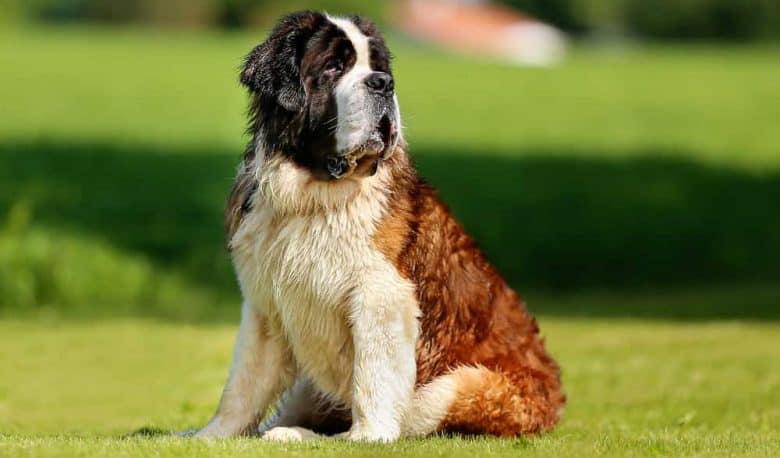
Intrigued? Keep reading to learn more about Saint Bernard!
Quick Navigation
- 1 History: where did the Saint Bernard originate?
- 2 Appearance: what does a Saint Bernard look like?
- 3 Temperament: are Saint Bernards good family dogs?
- 4 Are St. Bernards high maintenance?
- 5 What health problems do Saint Bernards have?
- 6 How much does a Saint Bernard cost?
- 7 Curious about Saint Bernard mixes?
- 8 Who should get a Saint Bernard?
- 9 Reference
History: where did the Saint Bernard originate?
You may recognize the Saint Bernard from the hit movie Beethoven, but this pup has a much bigger history than that.
In the 11th century, an Italian monk named Bernard de Menthon established a traveler’s hospice in the Swiss Alps. This was also known as the Saint Bernard Pass, between Switzerland and Italy.
The Saint Bernard was bred as search and rescue dogs. They found travelers buried by drifts and avalanches, getting their name from the monk who founded the hospice.
This dog breed is known for saving over 2,000 lives. A Saint Bernard named Barry is credited with saving over 40 people.
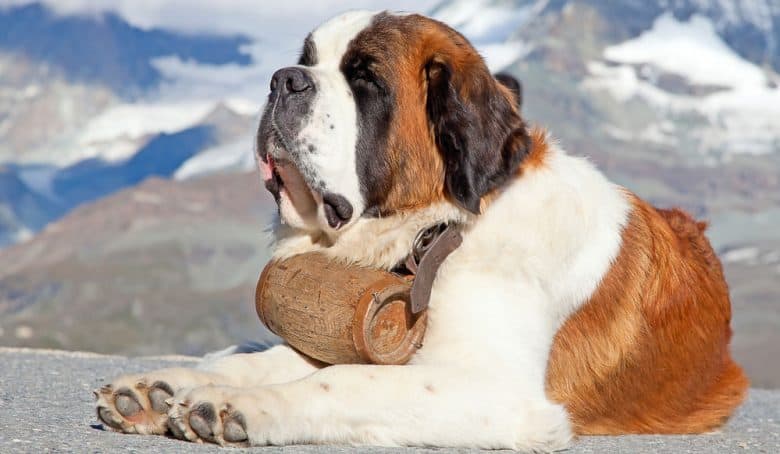
And no, this pup did not carry a keg of whiskey around their neck. Believe it or not, that came from a painting of the breed.
The symbol stuck with the public, leading people to believe Saint Bernards brought brandy on their rescue missions.
In addition to rescuing travelers, this dog breed was also known for guarding and herding on farms. They were known as Talhunds (Valley dogs) or Bauernhunds (Farm dogs).
Today, you won’t find these working dogs working much as they don’t find travelers anymore.
However, some of these mountain dogs are still at the Saint Bernard Hospice in Switzerlandares living representations of their ancestors’ rescue work.
You’ll find the Alpine Mastiff as a family dog now. They were brought over to the United States, Europe, and Russia in 1962.
The American Kennel Club (AKC) officially recognized these hospice dogs as part of the working group in 1885.
How did this doggo come to be, though? The purebred actually came from the Molosser, which is today’s Mastiff, among other large breeds.
With that knowledge, how can you spot a St. Bernard?
Appearance: what does a Saint Bernard look like?
How can you tell if your Saint Bernard is a purebred? First, you can talk to your veterinarian, and they’ll be able to tell you. You can also buy your doggo through a reputable breeder who knows the pup’s family tree.
Or, you can look at your pup’s general appearance and look for certain features, according to the breed standard.
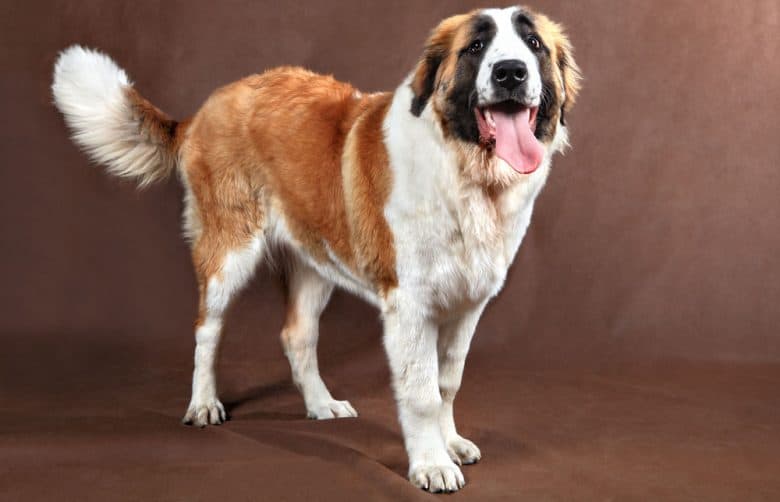
The Saint Bernard is proportionately tall, strong, and muscular.
With a wide skull and high cheekbones, the skin of his forehead above the eyes forms wrinkles. He’ll have a short muzzle and wide nostrils.
His neck is erect when alert but usually pointed downward when relaxed. The nape is muscular and round, making the neck look short. His dewlap of the throat and neck are well pronounced.
The shoulders are broad with a deep chest that’s well-arched. His back is broad and straight with a long tail.
He has powerful upper arms, strong lower legs, and muscular hind legs. The feet are broad with strong toes and high knuckles. The hocks on the hind legs are at a good angle.
Size: how big is a St. Bernard dog?
These pups are large dogs, with the males being a little bit bigger than the females.
Male Saints will grow as tall as 28 to 30 inches (71 to 76 cm) and weigh as much as 140 to 180 pounds (63 to 81 kg).
Female St. Bernards will grow to be about 26 to 28 inches (66 to 71 cm) and weigh about 120 to 140 pounds (54 to 63 kg).
Fun fact: the heaviest Saint Bernard was named Benedictine and he weighed 357 pounds (162 kg)!
When you bring home a Saint Bernard puppy, you’ll want to keep a note of their growth to ensure they’re on track and are healthy.
When they’re a newborn, your fido should weigh about 1.5 pounds (.6 kg). At three months, the females should weigh about 37 to 48 pounds (16 to 21 kg), and the males should weigh about 48 to 56 pounds (21 to 25 kg).
At six months, your female should weigh about 69 to 88 pounds (31 to 40 kg) while your male should weigh about 88 to 103 pounds (40 to 46 kg).
Your Saint Bernard dog will grow fast during his first year before slowing down. However, he won’t mature fully until he’s at least 2 to 3 years of age.
Seeing how large this pup gets, is there such a thing as a miniature St. Bernard? There is no such thing as a purebred mini Saint Bernard. However, you can get one if you cross this breed with a smaller doggo, such as a Cocker Spaniel.
The Saint Bernard will not make a good apartment dog with all that said. They need plenty of room to roam and stretch their legs.
Coat: is there a short haired Saint Bernard?
Most of the time, you often see a long-haired Saint Bernard, but this breed does, in fact, come with a short coat.
The short-haired Saints have dense fur that lies smooth. It’s tough but isn’t rough to the touch with a medium, flat double coat.
These were the first Alpine Mastiffs. To help the dogs with the Alps’ cold, monks mixed Saint Bernards with long-haired dogs such as Newfoundlands, believing the long coat would help them withstand the cold.
Instead, their long fur held onto the cold and ice, making them less resistant to the cold.
Whether this doggo is long-haired or short-haired, his coat can come in various colors.
- Brindle Grizzle
- Brown and White
- Mahogany and White
- Orange and White
- Red and White
- Rust and White
- White and Brown
- White and Orange
- White and Red
In addition, their coat can have two types of markings: black mask and brindle.
Temperament: are Saint Bernards good family dogs?
Saint Bernards are one of the best doggos to have in your home! They make excellent family dogs and are pretty social.
They’ll enjoy cuddling on the couch beside you, despite their massive size. They’re also great with other house dogs and are good with kids (even small children), making them excellent watchdogs.
Are Saint Bernards dangerous?
They’re not an aggressive breed, but they can show signs of aggression and be protective of the ones they love and their territory. They can be a good guard dog without getting aggressive.
It’s unlikely for a Saint Bernard to turn against its owner. However, like most dog breeds, they could show aggression. This is why it’s important to train your pup well and proper socialization.
Just take a look at this video of a Saint Bernard and his owner’s morning routine.
Overall, the Alpine Mastiff is a friendly dog breed. They’ll do great with strangers, other dogs, small dogs, cats, and other pets.
In fact, they’re so friendly and will enjoy socializing that they don’t do too well on their own. They’re prone to separation anxiety if left by themselves for too long.
This breed is relatively quiet and won’t bark a lot, but if they’re lonely, they may find their voice, singing a sad song to your neighbors.
The Saint Bernard is an intelligent breed. While it may take them 2 to 3 years to fully mature, they’ll be easy to train and potty train.
They’ll respond well to positive reinforcement and will enjoy being with you. Training this breed is a must and will need to be started at a young age.
As they grow bigger, they’ll get harder to manage if they’re not trained well.
Despite their size, Saint Bernards are not a lazy breed. They’re just a bit on the slower side, but these working dogs will enjoy having fun and training.
They enjoy swimming, but they can’t stay in the water for too long as they’re not natural swimmers due to their size.
However, they’ll love to cool off on a hot summer day. A game of fetch in the water will be fun for them as long as they don’t end up too deep in the water.
Are St. Bernards high maintenance?
This dog breed can be high maintenance in terms of care due to their coat and health.
For one, they are not outdoor dogs. Yes, they seem too large to fit inside the house, but they prefer to be with their family and are prone to overheating.
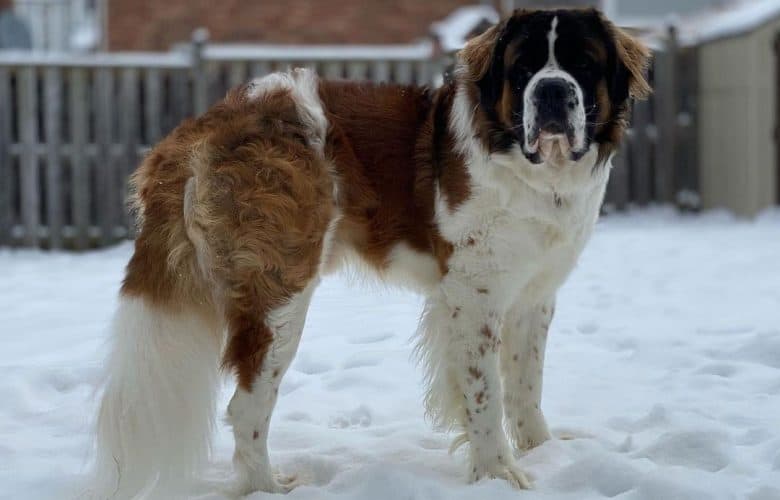
Saint Bernards can tolerate the cooler weather just fine, but they cannot handle the hot weather due to their coat, especially the long-haired variety. They may get heatstroke.
Exercise: how much exercise do Saint Bernards need?
The Alpine Mastiff has a moderate energy level.
They’ll enjoy a daily walk or even a hike that’s three to four miles long, given their mountain dog background. They’ll also like a game of fetch now and then.
However, they won’t make a great running or jogging partner for you. They’re slow and such exercise may hurt them.
Grooming: do St. Bernards shed?
First, Saint Bernards are not hypoallergenic. They are heavy shedders, no matter if they have short hair or long hair.
This doggo will shed moderately throughout the year but will go through two shedding seasons, typically in the spring and fall.
To keep the shedding at bay, weekly brushing is needed. You can use a deshedding tool or use a pair of grooming gloves while you and your fido cuddle.
Aside from the shedding, they’re fairly easy to groom. In addition to keeping their coat healthy, you’ll want to check their ears and clean them with a pet-safe ear cleaner often.
Trimming their nails and brushing their teeth regularly is also a must.
Whether your Saint Bernard is an adult or a puppy, you won’t need to bathe them too often. Every eight weeks is recommended to keep their fur and skin healthy.

When bathing your pooch, it may be best to do so outside or get a separate tub in your house or a walk-in shower.
Due to their massive size, bathing them will prove to be difficult at first until both you and your dog get used to it.
You can shave your St. Bernard, but be sure to talk to your vet about it first. You won’t want to shave them too close to the skin. If their fur has gotten too out of control and the weather is hot, shaving may be okay.
One big issue with this dog breed is that they drool—a lot.
Saint Bernards aren’t a smelly breed, but the drooling can build up on their face, causing a stench.
They drool a lot because of the jowls on their face. To minimize the drooling, keep your Saint Bernard as cool as possible. The heal will make it worse.
You can also use wrinkle wipes to safely and effectively clean their face.
Feeding: how much should a Saint Bernard eat in a day?
For a big dog, they’ll need to be fed a decent amount of food throughout the day to keep their strength up. However, too much can cause obesity, and that’s not a problem you want to have with your Saint Bernard.
As always, talk to your vet about the best dieting options for your doggo.
It’s recommended to feed your Saint Bernard puppy two cups of food split into three meals per day. As they grow older, you can push it to four cups per day.
As an adult, fully grown, your St. Bernard can have five to six cups into two meals per day.
Human food and table scraps are a no-no for a Saint Bernard. They should stick to their dog food and diet from the vet.
What health problems do Saint Bernards have?
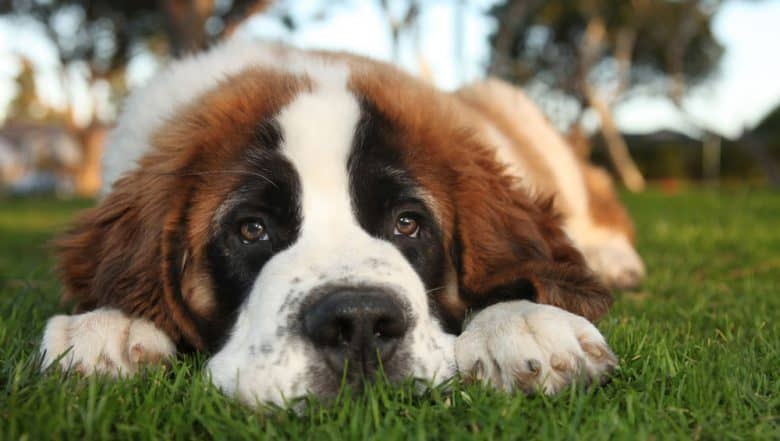
Unfortunately, Saint Bernards have quite a list of health issues. These concerns may include:
- Gastric Dilatation-Volvulus (GDV, Gastric Torsion, or Bloat)
- Hip Dysplasia
- Knee Dysplasia
- Elbow Dysplasia
- Osteochondrosis
- Osteosarcoma (bone cancer)
- Osteochondritis Dissecans (OCD)
- Epilepsy/Seizures
- Diabetes
- Allergies
- Cervical Vertebral Instability
- Degenerative Myelopathy
- Hypothyroidism
- Von Willebrand’s Disease
- Thrombopathia
- Eye, eyelid, and eyelash problems
- Entropion
- Ectropion
- Cataracts
- Distichiasis
- Heart conditions
- Dilated Cardiomyopathy
- Cardiomyopathy
Other health issues may include hotspots, heatstroke, and obesity.
Saint Bernard may be prone to some of these issues more than others, such as hip dysplasia, elbow dysplasia, entropion, and bloat.
While not all of these concerns can be tested ahead of time, you can still do some health screenings to catch some of these issues early.
With the help of your vet, you can ensure your Saint Bernard is in tip-top shape and as healthy as can be.
- Ophthalmologist Evaluation for Canine Eye Registry Foundation (CERF)
- Cardiac Exam
- Degenerative Myelopathy DNA Test
- Tests from the Orthopedic Foundation for Animals (OFA) for
- Hip Dysplasia
- Elbow Dysplasia
- Hypothyroidism
- Von Willebrand’s Disease
- Tests from the Auburn University for:
- Thrombopathia
- PennHip certification can be done for the:
- Hips
Since Saint Bernards are giant dogs, they don’t have a long life expectancy. Their lifespan is about 8 to 10 years.
This doesn’t mean they can’t live long, healthy lives. The longest living St. Bernard was 12 years old and nine months in the UK.
However, this dog breed is prone to heart conditions, which generally causes death.
How much does a Saint Bernard cost?

Depending on where you get your St. Bernard and from who, they can cost a few thousand.
Saint Bernard puppies will cost, at the minimum, about $1,500. It can be more or, if you’re getting an older Saint, it will be less than what the puppies typically cost.
If you’re thinking of adding a Saint Bernard to your home, then expect to spend about $1,300 per year after the first year.
This cost includes many things, such as:
- High-quality dog food
- Various accessories (bed, crate, leash, collar, harness, etc.)
- Toys
- Vet and other medical bills
- Grooming
- And more
It’s unlikely you’ll find a purebred Saint Bernard at a pet store, but there’s no harm in asking your local store.
The best way to get a St. Bernard pup is to go through a breeder or rescue.
Saint Bernard breeders
Finding a reputable breeder is the way to go if you want to be sure of your pup’s family history.
Remember, when looking for the right breeder to give you your next furry best friend, keep these things in mind – a good breeder will:
- Have knowledge about the breed
- Have knowledge about the puppy’s mother and father and family tree
- Socialize the puppies
- Want to meet you in person before selling to you
- Allow you to meet the puppies and parents
- Not let the puppies go until they’re at least eight weeks old
There are many breeders out there that specialize in Saint Bernards. A few good ones are listed below.
- Penokee Mountain St. Bernards (Marengo, WI)
- Medicine Creek Kennels (Cambridge, NE)
- Red Barn Saint Bernards (Portland, OR)
A great way to search for great breeders is also through the AKC Marketplace and the Saint Bernard Club of America.
Saint Bernard Rescues
Many dogs don’t yet have a home. So, if you’re looking for a purebred Saint Bernard, be sure to check out a shelter or rescue. These pups are waiting for their forever home!
Be sure to check out the ones listed here:
- Saintly Bernards Rescue (Ambler, PA)
- Gentle Giants Rescue (Riverside County, CA)
- Saints Among Us (Bissell, IL)
You can also check out the Saint Bernard Rescue through Rescue Me, where you can narrow down pups in your state.
Curious about Saint Bernard mixes?
Saint Bernards can also be crossed with other dog breeds to make more wonderful companions for your home.Here are just a few.
Saint Bernard Poodle mix

Also known as the Saint Berdoodle, this crossbreed will make a good family dog. They’re great with children though they may not like to be home alone for too long, or else they’ll get separation anxiety.
Their energy levels will be moderate to high since the Saint Bernard is more laid back, but the Poodle is fairly active. They’ll enjoy a house with a fenced-in yard.
The Saint Berdoodle can have a coat like either parent – wiry and curly of the Poodle or the short or long-haired coat of the Saint Bernard.
This pup will typically be 15 to 30 inches (38 to 76 cm) tall and weigh as little as 40 pounds (18 kg) and as much as 180 pounds (81 kg).
Its lifespan is about 8 to 12 years.
Saint Bernard Husky mix

Another fun hybrid is the Saint Bernard Husky mix, also known as the Saint Berhusky.
This pooch will live about 9 to 12 years. They’ll weigh about 70 to 90 pounds (31 to 40 kg) and grow to be about 22 to 25 inches (55 to 63 kg) tall. So, not as big as the Saint Bernard, but it’s still a good-sized pup.
This doggo will make an excellent watchdog. They’re smart and independent, which may make training a process.
They’ll make a great family dog, though, as they love kids and other pets as long as they’re properly socialized. They’ll enjoy meeting new people and welcome strangers, too.
Be careful; they’ll have a thick coat as a perfect mixture of their parents. They’ll shed quite a bit because of this.
Labrador Saint Bernard mix

The Labrador Retriever and the Saint Bernard crossed together is called the Labranard.
They’re an affectionate, friendly, and patient breed. They’ll enjoy going out with their family most of the time.
Due to their high energy levels, they’ll need plenty of room to stretch their legs and roam around. A house with a fenced-in yard is ideal.
This crossbreed’s average size is 23 to 27 inches (58 to 68 cm) and will weigh about 98 to 220 pounds (44 to 99 kg). The males will typically be taller and heavier than the females.
With their thick, double coat, this fido will need regular brushing to keep the shedding at bay.
Saint Bernard Great Dane mix

This gentle giant is also known as the Saint Dane or the Great Bernard. They have an average lifespan of about 6 to 10 years so that you won’t get much longevity out of this pup.
However, they can still live a long, happy, and healthy life in your home.
This mixed breed will shed a lot with their short, silky coat. However, it can take after the Saint Bernard parent and have a longer coat.
They’ll also drool a lot and will need plenty of space. A house with a fenced-in yard is just what this pooch needs to thrive.
Despite their massive growth of 23 to 32 inches (58 to 81 kg) and weighing 155 to 200 pounds (70 to 90 kg), this pup is friendly and protective.
They’ll make a wonderful family dog and love children.
German Shepherd Saint Bernard mix
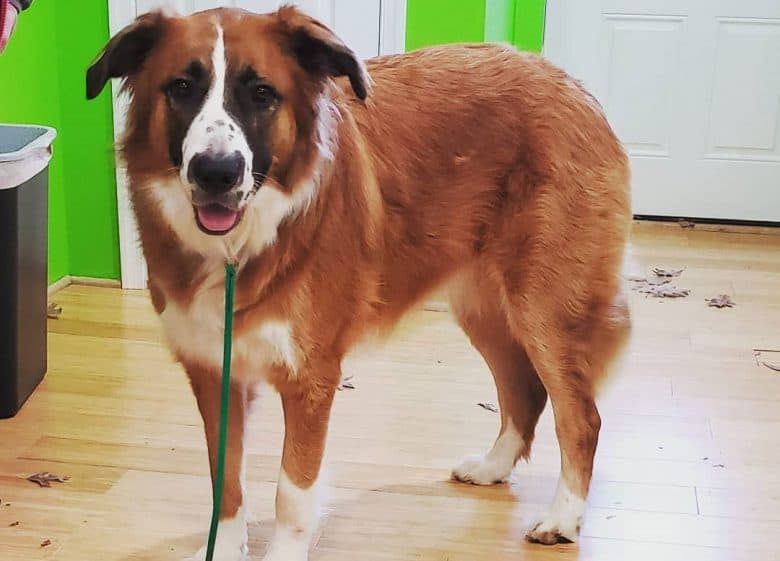
This crossbreed, also known as the Saint Shepherd, will be a wonderful addition to any home.
They can be a good guard dog but will most likely be loving and gentle with others. This includes kids, making them a good choice for a family dog.
However, they’re intelligent and can be stubborn at times.
This pooch will have a thick double coat that will keep them warm in the cooler months but will be prone to overheating in the warmer months.
Almost daily brushing is a must to keep the shredding in control so their coat won’t get matted.
The German Shepherd Saint Bernard mix has a life expectancy of 8 to 12 years.
They’ll grow to be about 25 to 31 inches (63 to 78 kg) and weigh 85 to 150 pounds (38 to 68 kg), with the males being slightly taller and heavier than the females.
Who should get a Saint Bernard?

If you’ve never owned a dog before, this breed can be hard to manage. Plus, if you enjoy a clean house, then keeping their shedding and drooling under control will be a must.
However, they’re loyal and friendly to just about everyone they meet. If you have a big enough house, then consider this pup.
Are you thinking about getting a Saint Bernard? Let us know in the comments!
Reference

Cess is the Head of Content Writing at K9 Web and a passionate dog care expert with over 5 years of experience in the Pet Industry. With a background in animal science, dog training, and behavior consulting, her hands-on experience and extensive knowledge make her a trusted source for dog owners.
When not writing or leading the K9 Web content team, Cess can be found volunteering at local shelters and participating in dog-related events.