Anyone who loves Disney classics knows the movie 101 Dalmatians, and isn’t it such a dream to get smothered by that many puppies?
Endearingly called Dals, there’s more to these spotted canines than what the big screen showed us.
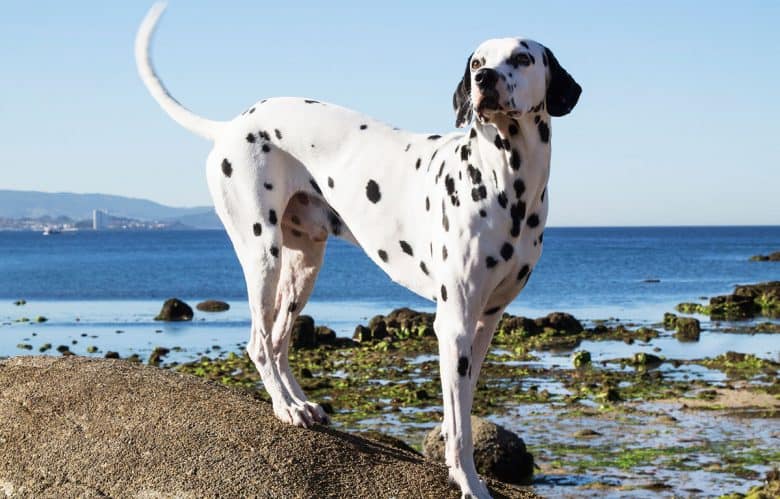
Keep scrolling, and let’s find out more about the sleek and athletic Dalmatian dog.
Where did the Dalmatian dog originate?
It is said that this purebred has been around for hundreds of years, but no one knows its exact origin. Others also think that the spotted Great Dane and English Pointer were the ancestors of this pooch.
What’s known is that they were first named after the province on the eastern shore of the Adriatic sea called Dalmatia, which is now Croatia.
Still, it was in England during the 1800s that they were developed and made an actual name for themselves.
They became the definitive spotted coach dog where they cleared paths for horses, ran beside and under it, and guarded it.

Every fashionable lady and lord had these flashy carriage dogs by their side. Plum Pudding Dogs is how some British people call them because of their Christmas plum pudding-looking spots.
If you’ve seen the Budweiser Clydesdales, you may have noticed Dals accompanying them on parades, but Dalmatians have always had a natural connection with horses.
When they took a different career path in the US, they served as firehouse dogs beside the majestic animals with their horse-drawn fire engines.
No wonder many fire stations today have the Dalmatian as their mascot – they’re excellent at it! They didn’t just sit still.
They took their watchdog duties seriously and acted when people had to be rescued from burning buildings.
From there, this dog breed’s versatility was pushed that they were also used as retrievers, hunters, ratters, draft dogs, war sentinels, and even as circus dogs.
In 1888, they joined the American Kennel Club (AKC) under the Non-Sporting Group. A few years later, around 1905, the Dalmatian Club of America was formed.
As the years passed, more organizations recognized Dals, including:
- Fédération Cynologique Internationale (FCI)
- American Pet Registry, Inc. (APRI)
- North American Purebred Registry, Inc. (NAPR)
- New Zealand Kennel Club (NZKC)
- Dog Registry of America, Inc. (DRA)
- Continental Kennel Club (CKC)
- American Canine Registry (ACR)
- American Canine Association Inc. (ACA)
- Canadian Kennel Club (CKC)
- National Kennel Club (NKC)
- Kennel Club of Great Britain (KCGB)
- Australian National Kennel Club (ANKC)
And being companion dogs, they are recognized as such by the United Kennel Club (UKC).
Note: Many breed clubs accept Dalmatians, and some refer to them based on language. In French, they’re known as Dalmatien. They’re called Dalmata in Español, while Dalmatiner in Deutsch or German.
What do Dalmatians look like?
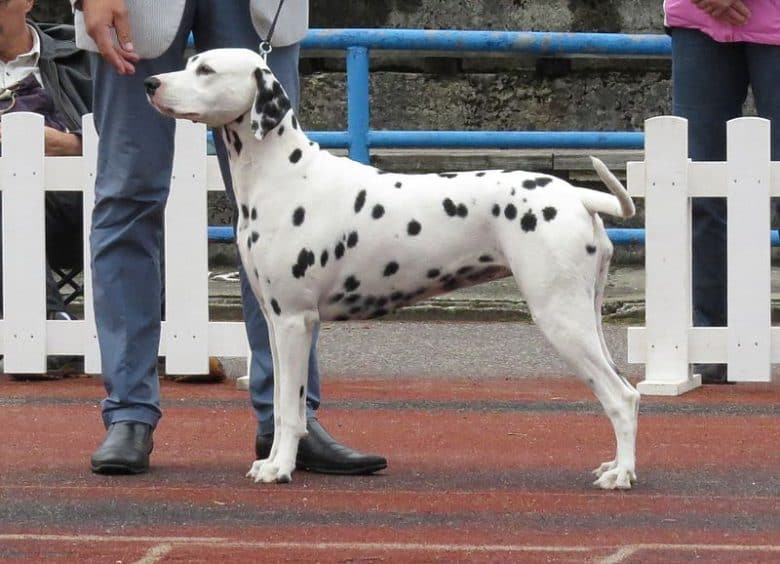
Dalmatians are probably one of the most recognizable breeds.
As per their AKC breed standard, they have a muscular, deep-chested, and square-proportioned build that gives them an imposing and athletic stature. It makes them move and trot efficiently and effortlessly.
Set high on their long, flat-topped skull are floppy ears with a rounded tip.
They have round eyes that give the breed an intelligent and alert expression. It can be brown or blue in color, or it can be one of each.
Their noise can be brown (liver), black, dark gray, or blue that kind of looks black.
Size: How big do Dalmatians get?
Around 16 months of age, a Dalmatian puppy will reach its full-grown size and have a height of 19 to 24 inches (48 to 61 cm) and a weight of 40 to 60 pounds (18 to 27 kg).
Like with most dogs, females are a little smaller than males.
The size may still vary, but if you want your dog to be registered with the AKC or you want him to join conformation events, he should be within those measurements.
Medium- to large-sized breeds like the Dalmatian aren’t suitable for apartment-dwellers, especially if we consider their energy level.
We recommend them to live in a house with an average-sized yard where they can run and romp anytime.
Wondering if there’s a Miniature Dalmatian? There is. Mini Dalmatians stand around 8 to 15 inches tall and weigh 18 to 24 pounds.
Fair warning, though. Miniature Dals are created in different ways that aren’t beneficial to the dogs.
They either repeatedly breed from runts, mix them with a smaller breed (crossbreeding), or introduce the dwarfism gene.
The satiny, sleek coat of Dalmatians
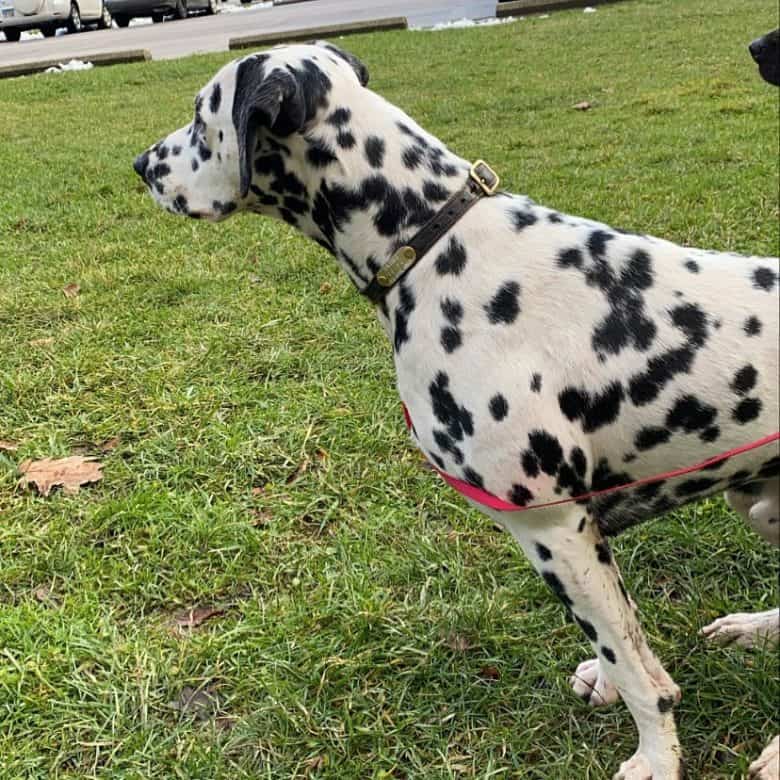
Dals have a flat and short coat that’s fine and feels like velvet to the touch.
For color, they have a white coat base covered with well-defined black spots — like dime-sized. It’s distributed all over their body, and you can expect smaller spots on their head, ears, legs, and tail.
It is thought that a mutation in a ticked-coat gene may cause their spots, but it’s a mystery where they actually come from.
Aside from black, some have liver or brown spots, which are both preferred in dog shows.
Surprisingly, some Dalmatian spots can be dark blue, tricolored, sable, brindle, lemon, and others can have a solid white coat. Still, these colorations aren’t included in their breed standard.
White and black

The most common color is black and white. Black-spotted Dals have pure black spots and are considered a dominant color,
White and liver
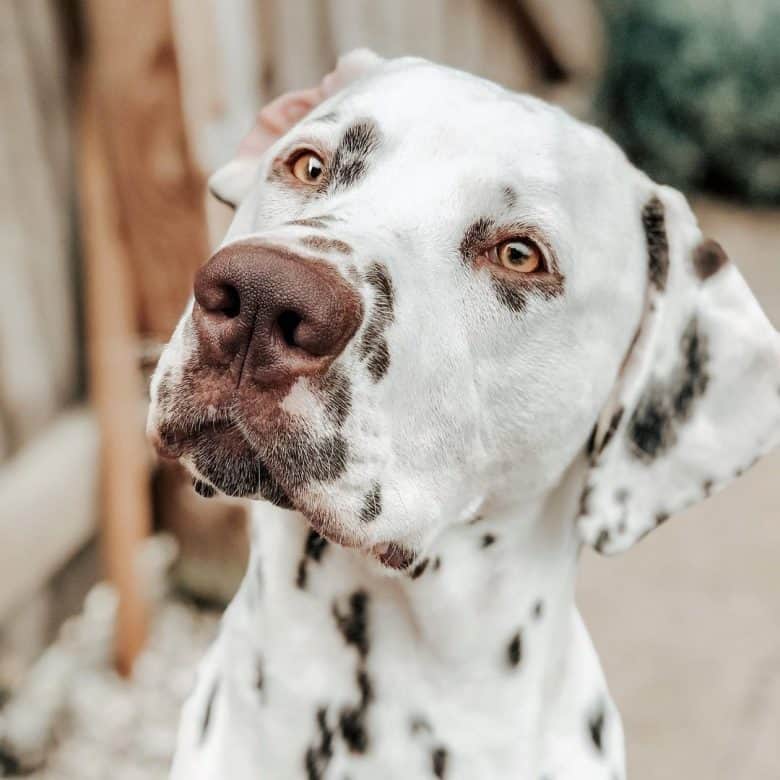
Liver or brown is the only other acceptable color in the show ring for Dalmatians. They’re a recessive color and do not carry any black at all.
White and lemon
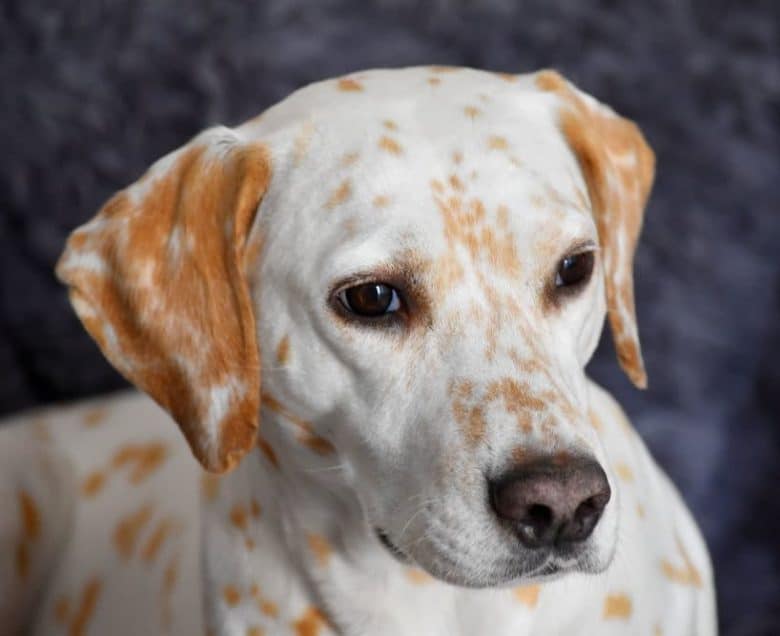
Lemon-spotted Dalmatians have yellowish spots. The shade can range from bright orange to a pale yellow and is simply referred to as Lemon.
White and orange
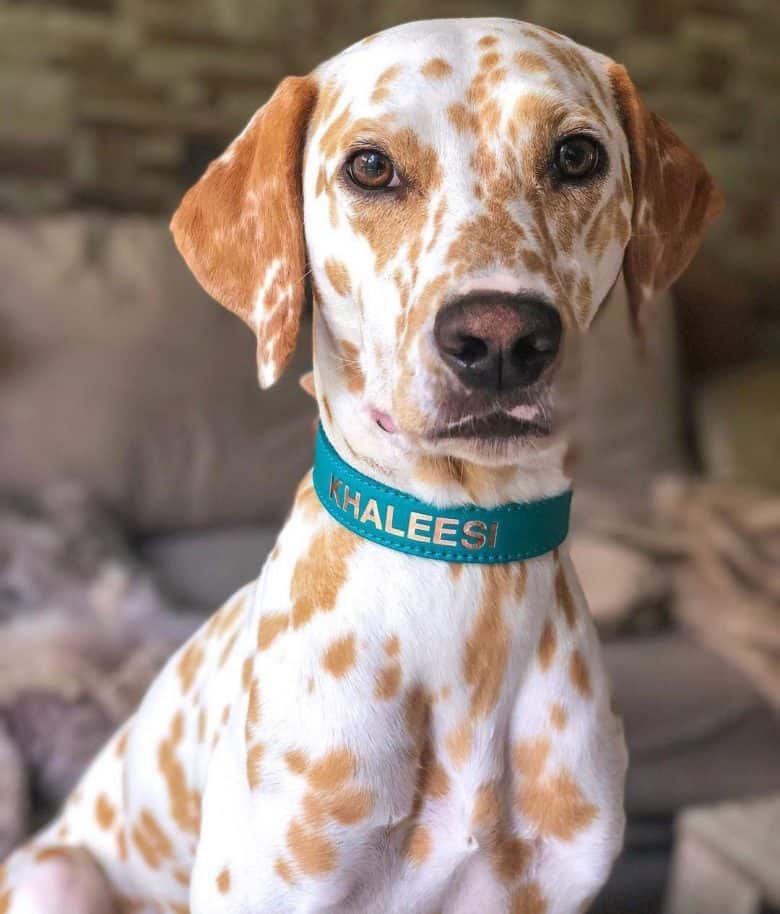
This coat color seems like a liver, but those are more “chocolatey” and have brown noses. Orange-spotted Dals have a black nose and actual orange spots.
White, black, and tan
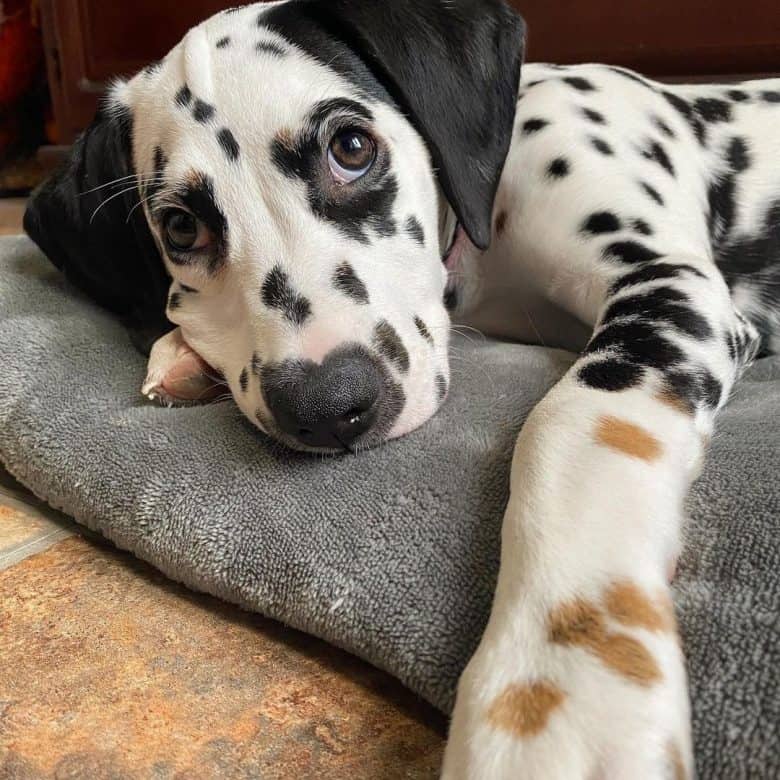
Also known as tri-colored, these Dalmatians can either have a white, tan, and liver coat OR a white, tan, and black coat. Regular spotted Dals wouldn’t have black spots on a liver dog or vice versa.
Brindle Dalmatian

Brindle isn’t a coat color, but a pattern seen on dogs with a fawn coat with dark stripes. Dals that are brindle-marked are more visible on the tan areas.
Sable Dalmatian

Sable Dals look like Lemons, but they have dark hairs scattered and mixed with their brownish spots.
Blue Dalmatian
If you’ve seen Dalmatians with spots that look gray or silverish, it’s a blue-spotted Dal. They’re very rare, but they have captivating eyes that are a mixture of gold and gray, and their nose is dark gray.
Want to see more of the Dalmatian’s rare colors? We found this video for you:
Are rainbow Dalmatians real?
Rainbows Dals don’t exist. If you’ve seen one on Facebook or Instagram, a groomer did that. Their white fur seems like a canvas for other people that they put different colored-spots on them.
Temperament: Is a Dalmatian a good family dog?

As charming as they seem in films, Dalmatians aren’t for everyone. No matter how attractive a breed may be, please don’t decide about getting a dog based on its appearance.
Sure, the Dal is always interested in everything their humans do and can make excellent playmates for kids, but only for those who are six years old and above.
Any younger and they can get easily knocked down by an exuberant dog and its swishing tail.
Just take precautions and always supervise interactions between your pup and small children, including small pets.
They can get along fine with anyone, like cats, given that they had early socialization and are appropriately trained.
When it comes to strangers and other dogs, Dals can be reserved and aggressive. But only if they weren’t properly trained and socialized. Some are timid, while others can be high-strung.
Do Dalmatians get separation anxiety?

This is expected from a dog who thrives on human companionship because it means they don’t like spending time alone for long periods.
Not only can this lead to depression, but also destructive tendencies like chewing and digging.
You can also expect barking from Dals, but only to do their watchdog and guard dog duties.
This an alert breed, so anything interesting and your pooch will let you know about it. And if the situation calls for it, they’ll show their protective side.
They’re quite goofy when at home with their family, but they’re quiet and courteous when in public.
Any misbehavior can be dealt with early training. Dalmatians are highly intelligent, and we recommend that you start teaching this smart dog as early as eight weeks of age.
By 10 to 12 weeks, you can enroll him in puppy kindergarten.
Dals can be a bit headstrong, and they’ll distract their owners with their clownish antics, so you have to be firm and consistent. Fair warning, though.
Dalmatians are sensitive canines that are said to have excellent memories. Any mistreatment and they’ll never forgive you for it. Make training sessions fun and positive, and give plenty of praise and treats.
How to take care of your Dalmatian dog
Overall, Dals are considered high-maintenance, but we can say that’s debatable. If they’re with the right people who know how to handle a stubborn, rambunctious, and suspicious breed, they make excellent pets.
Caring for them is also a factor. They may be adaptable to warm, temperate climates, but they’ll act up if left to live in the backyard on a chain.
Here’s what you have to know to keep your Dalmatian happy and healthy.
Exercising your Dalmatian
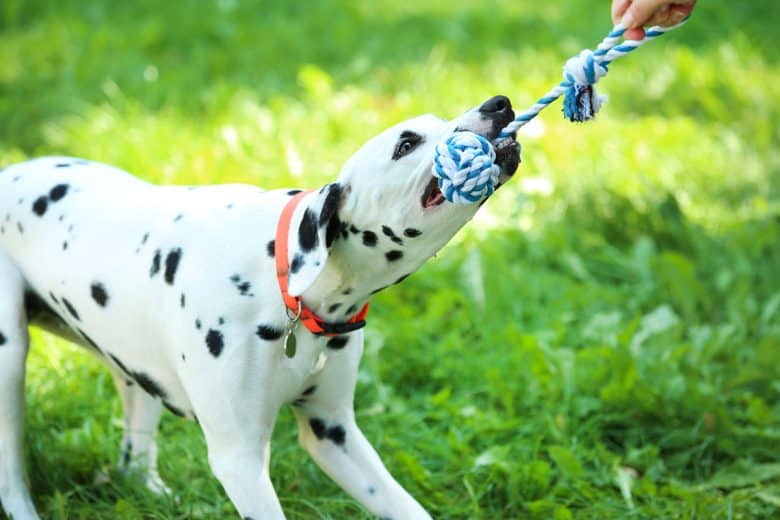
Dalmatians are high-energy dogs that require 30 minutes to an hour of daily exercise.
Did we mention that they’re fast runners? When out on walks, keep your Dal on a leash unless you can match his stamina. Don’t forget to have your outdoor space securely fenced.
If you’re looking for an active dog to go hiking, backpacking, or jogging with you, then that endless capacity for exercise wouldn’t be a problem.
They’re also excellent competitors in numerous canine sports like frisbee, flyball, agility trials, and obedience competitions.
Whether or not you have experience in the show ring, Dalmatians have the right combination of personality and looks. With the right training, your fido may be a champ!
The Dalmatian Club of America has been sponsoring a program where they’re continuing the breed’s history as carriage dogs.
They offer titles such as The Road Dog (RD) and Road Dog Excellent (RDX), where your dog has to accompany carriages and horses for a certain number of miles, then perform basic obedience.
Your doggo can join these trials that are often held in conjunction with national shows and larger specialty shows sponsored by this parent club.
The grooming needs of your Dalmatian
Dalmatians shed but are pretty low maintenance in terms of grooming. Weekly brushing can keep the shedding under control.
But some Dal owners have a common joke that “the only two different times: during the day and the night.” With that said, if you can brush your fur buddy more frequently, the better.
Equip yourself with a hound mitt, bristle brush, or a rubber curry brush to strip out dead hair and make his coat gleam.
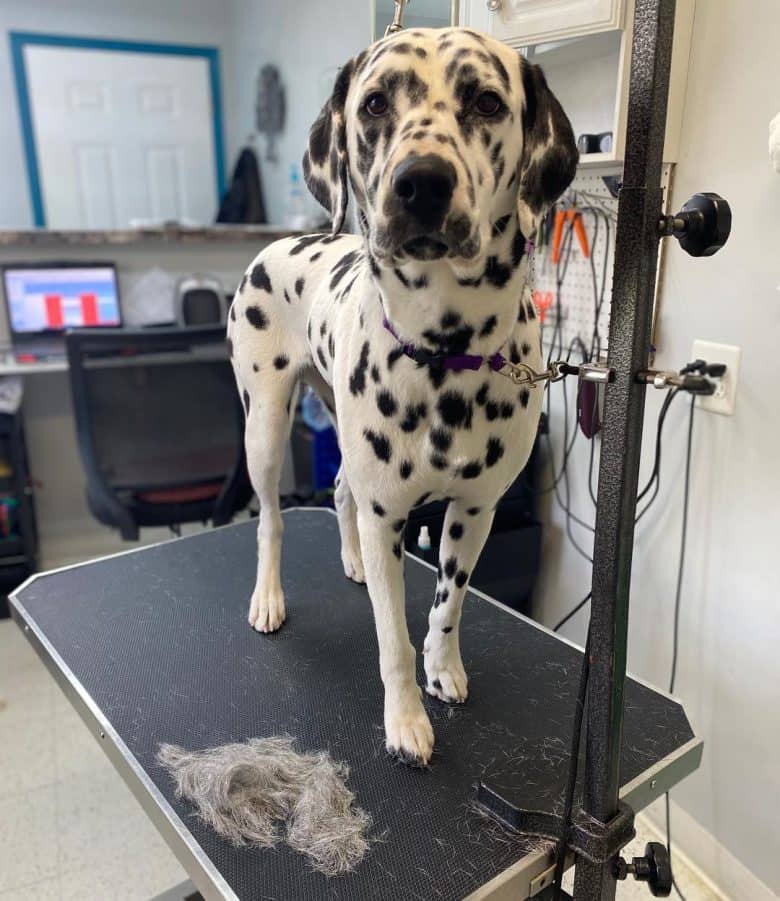
Their coats are dirt-repellant, and Dals like to stay clean, so you can expect little to no doggy odor.
Bathing him three to four times a year is enough because any more frequent than that can strip the natural oils and make his skin dry and flaky.
Other grooming routine covers having their ears checked and cleaned weekly, their teeth brushed at least twice a week, and nails trimmed once or twice a month.
As you groom, take the time to check for any rash, sores, redness, inflammation, or tenderness on your pup’s skin, eyes, nose, mouth, and paws.
It’s best to catch early signs of infection before it leads to serious health conditions.
Feeding your Dalmatian with the recommended diet
A Dalmatian needs 1.5 to 2 cups of high-quality dry kibbles daily, and it should be divided into two meals to avoid obesity. How much you feed your pet should depend on his age, weight, and activity level.
You can still adjust this amount because highly energetic dogs will need to consume more dog food to refuel.
You can use this calorie calculator to compute how much food your Dalmatian has to eat based on his daily caloric requirements.
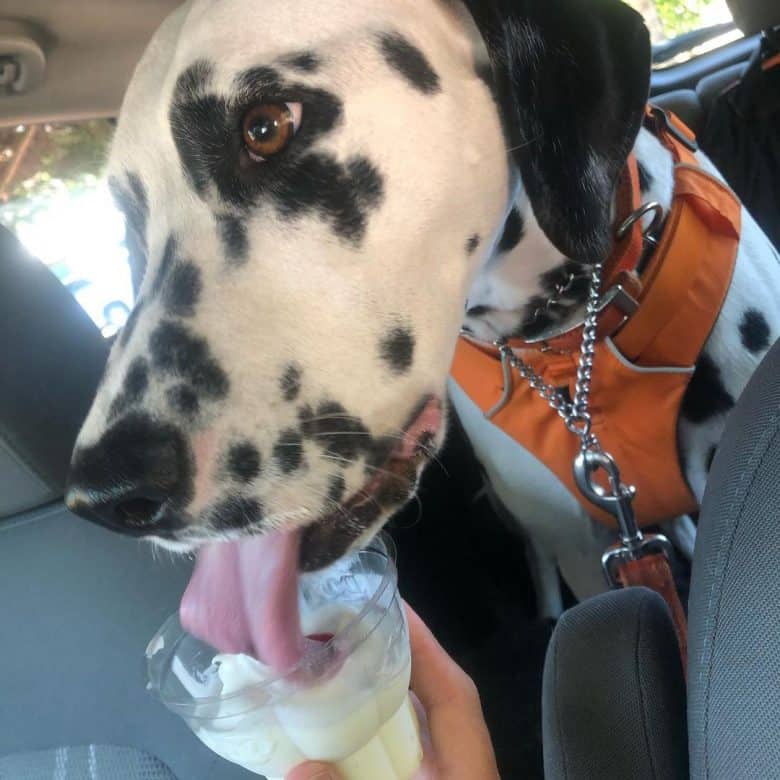
It’s crucial that your Dalmatian have free access to freshwater all the time. They have a unique urinary system from other dog breeds where they need to relieve themselves more frequently.
Observe your Dal if he’s urinating regularly because of their uric acid metabolism, which makes kidney stones build up and leads to urolithiasis.
If your dog suffers from urinary stones, you can check with your vet if you can give him a veterinary diet or recipe.
Some of the urinary care dog food we found are Royal Canin Urinary SO and Hills Urinary Care. We want to emphasize that you check first with a trusted vet before changing your Dalmatian’s kibble.
Health concerns: How long do Dalmatians live?
Dals are generally healthy and have a lifespan of 10 to 16 years. Although, they do suffer from many health problems, which is not uncommon for most purebreds.
Some of the health issues they’re prone to are ear problems, elbow and hip dysplasia, Von Willebrand’s disease, thrombopathia, and hypothyroidism.
Another prevalent disease in Dalmatians is hereditary deafness. This polygenic trait that causes hearing issues can be passed long from all Dalmatian bloodlines to their offspring.
It is said that about 8%of Dals are born completely deaf, while 22 to 24% are born with only one ear functioning.
The Dalmatian Club of America recommends that puppies found completely deaf should be euthanized because they’re more difficult to train and may bite if startled.
Those who have experience owning and caring for deaf dogs beg to differ.
They believe that any canine suffering from deafness can be trained with hand vibrations and signals, so they are less likely to be surprised and still be amazing pets.
Some pups who have hearing impairment undergo the BAER or Brainstem Auditory Evoked Response.
This Dalmatian named Logan defy being deaf by showing that he’s more functional than a regular dog:
How much do Dalmatian puppies cost?
The price range for this purebred is quite huge. A Dalmatian puppy can cost $300 to $3,000.
On average, you can buy a pup for around $900 from a reputable breeder. Still, consider other factors that can affect how much you’ll pay to get this canine.
There are the breeder’s popularity and location, the Dalmatian parents’ lineage, the puppy’s availability, and even the gender of the Dal you like.

Speaking of availability, Dalmatians can’t give birth to 101 puppies. The most that they can have in a litter is 15 pups.
Still so, think about the expenses that come with owning a dog, whether it’s a Dalmatian or not.
Aside from the usual doggy bed, bowls, leash, collars, grooming tools, and dog food, there are also check-ups, vaccinations, emergency medical bills, and more.
Dalmatian breeders: Buying a Dalmatian puppy
Once you’ve done your research, prepared your questionnaire, and you’re sure that the breeder you’re working with is responsible and have their dog’s best interest in mind, you can start browsing for pups.
Here are some breeders and kennels that have available Dalmatian puppies for sale:
- Alpha N Omega Dalmatians (East Granby, CT)
- Westview Dalmatians (San Diego, CA)
- Prestige Dalmatians (Central NJ)
The AKC Marketplace is also a great starting point for finding a Dalmatian puppy near you.
Rescues: Adopting a Dalmatian dog

If you want to save money and the life of an innocent fur angel, adoption is an option you should consider.
Plus, adopting an older dog also means you won’t have to worry about the extra work that raising a pup entails.
Besides that, shelters make sure that before a dog gets adopted, they’ve already done basic training and had necessary vaccinations. You’ll also be aware of the adult canine’s temperament and health issues.
Convinced that this is your path to getting a Dal? Check out these rescue organizations. And who knows, you might also like the Dalmatian mixes they care for:
- Dalmatian Rescue of Colorado (Loveland, CO)
- Adopt A Spot Dalmatian Rescue, Inc. (Chesapeake, VA)
- Chocolate Chip Dalmatian Assistance League (Adelphi, MD)
If you want to give a deaf dog a chance because you have the time, money, and experience, you can visit the site of Deaf Dogs Rock. They have other breeds there, so you’ll have lots of options.
Who should get a Dalmatian?

Dalmatians are fantastic companions for active families who are always out and about, as well as those who enjoy doing different activities and joining canine competitions.
They’ll be the absolute best friend of older children who always wanted a pet. They may have some quirks like being clingy, protective, wary of strangers, and such, but what dog doesn’t.
So, with the right combination of discipline, exercise, care, and love, Dals will be a great addition to your household.
Ready to join the Dalmation (pun intended)? Let us know what you think about Dalmatians by leaving a comment below.
Further reading: Similar breeds to Dalmatians
Reference
- https://commons.wikimedia.org/wiki/File:Old_fire_engine_and_dalmatian.jpg
- https://commons.wikimedia.org/wiki/File:Dalmatian_in_Tallinn.JPG
- https://www.vetfolio.com/learn/article/urate-urolithiasis#:~:text=In%20dalmatians%2C%20an%20autosomal%20recessive,disease%2C%20specifically%20portosystemic%20vascular%20anomalies.&text=Ammonium%20urate%20uroliths%20are%20most%20common.
- https://www.ufaw.org.uk/dogs/dalmatian-deafness#:~:text=The%20genetic%20deafness%20seen%20in,of%20the%20organ%20of%20Corti.&text=Dalmatians%20are%20usually%20born%20with%20normal%20hearing%20but%2C%20in%20affected,%3B%20Johnsson%20et%20al%201973).

