The fluffy outer coat of this exquisite dog has resulted in the affectionate nickname of the mop dog. But never let its mop-like appearance fool you. Beneath all the hair is a smart and agile hound with a heart to protect.
First bred in Hungary as a sheepdog (hence the name Hungarian sheepdog), the Komondor loves to watch over and protect its family.
Keep on scrolling, and let us find out more about the Komondor dog breed’s uniqueness!
The ancient origins of the “Mop Dog”
Descending from Tibetan dogs and the Russian Caucasian Ovcharka (also spelled Owtcharka), the Komondor, or the Dog of the Cumans, is an ancient breed from Hungary, with its earliest records dating back to the 16th century.
Fun fact: The Hungarian plural of Komondor is Komondorok.
With its curly wool white coats, it has a striking resemblance to the Magyar sheep. This livestock guardian mingles with the flock of sheep seamlessly, which will surprise any oblivious predator.
Many believe that this purebred is responsible for wiping out Hungary’s wolf population.
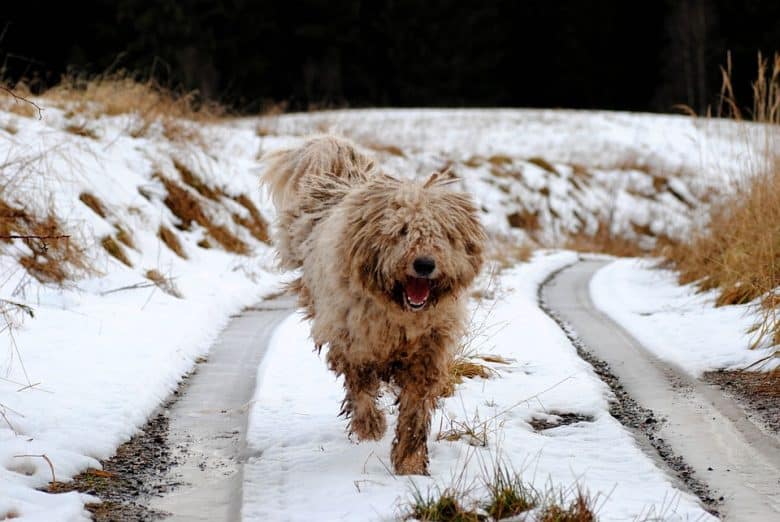
During World War II, the entire breed nearly vanished in Europe. Fortunately, Kom breeders and enthusiasts worked hard to restore the breed, but their line remained rare, with a small population of around 10,000 worldwide.
Found mainly in its native country of Hungary, the Hungarian Komondor made its way to the United States in 1933.
By 1937, the American Kennel Club (AKC) recognized the Komondor, along with these other organizations:
- American Canine Registry (ACR)
- American Canine Association Inc. (ACA)
- American Pet Registry, Inc. (APRI)
- Australian National Kennel Club (ANKC)
- Dog Registry of America, Inc. (DRA)
- Canadian Kennel Club (CKC)
- Continental Kennel Club (CKC)
- Kennel Club of Great Britain (KCGB)
- Middle Atlantic States Komondor Club (MASKC)
- North American Purebred Registry, Inc. (NAPR)
- National Kennel Club (NKC)
- United Kennel Club (UKC)
- New Zealand Kennel Club (NZKC)
- Fédération Cynologique Internationale (FCI)
What does a Komondor dog look like?
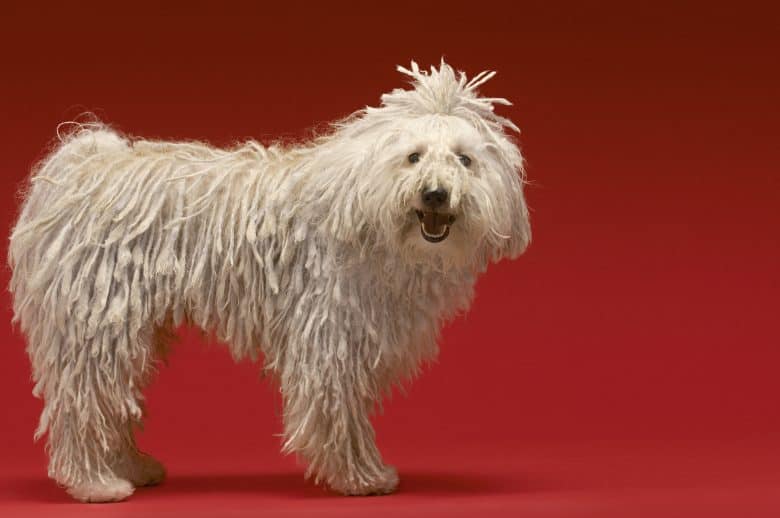
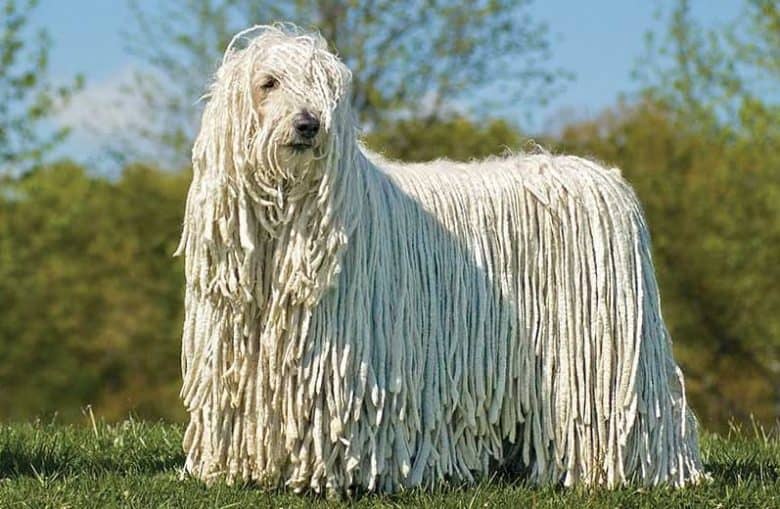
You can’t miss a Komondor coming. Striking and unique in appearance, this dog is easy to identify with white coats that often resemble dreadlocks.
These strong, tassel-like cords run from head to tail, forming the dog’s outer coat.
The Komondor’s coat has two layers — an undercoat that is soft and woolly and an outer fur that is coarse and dense.
Komondor puppies have soft and wavy hair at an early age. Once they become adult dogs, the outer coat becomes coarse and felty, forming cords.
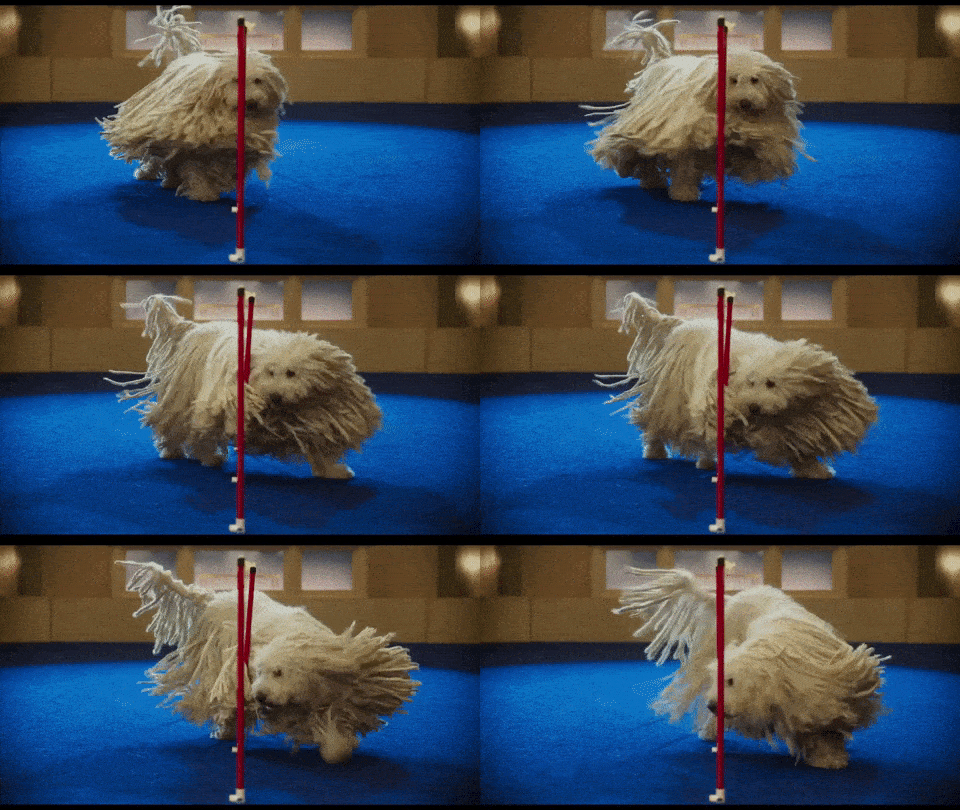
These dreadlocks protect the canine from harsh weather and predators while blending in well with its surroundings when attending to its sheepdog responsibilities.
And if you think that it gets in the way of the Komondor’s eyesight, well, given its job as a watchdog, it’s unlikely to have any significant effect.
The mop of hair does not jeopardize the speed at which this canine can run either. With strong forequarters and hindquarters, this dog takes long strides and is a fast responder.
Meanwhile, beneath those felty white cords of its outer coat, the Komondor sports a pair of dark brown eyes and a black nose.
This dog also has a large head and a robust, medium-length neck that flows effortlessly into its rugged body of powerful muscles, heavy bones, and a deep chest.
A Kom with blue eyes and a flesh-colored nose, along with a few others, are grounds for disqualification.
Want to see how cute the Komondor dog is? Watch this video:
How big do Komondor dogs get?
When fully grown, the Komondor is a large dog. With males growing to a minimum height of 27.5 inches (70 cm) and weighing 100 pounds (45 kg) or more.
Females are slightly smaller. They’re at least 25.5 inches (65 cm) with a weight of 80 pounds (36 kg) or more.
Given this flock guardian dog’s size and natural affinity to being outdoors, apartment living does NOT suit a Komondor.
For your pet to get his daily exercise, we recommend a spacious home with a large yard and secure fence.
Temperament: Are Komondors good family dogs?
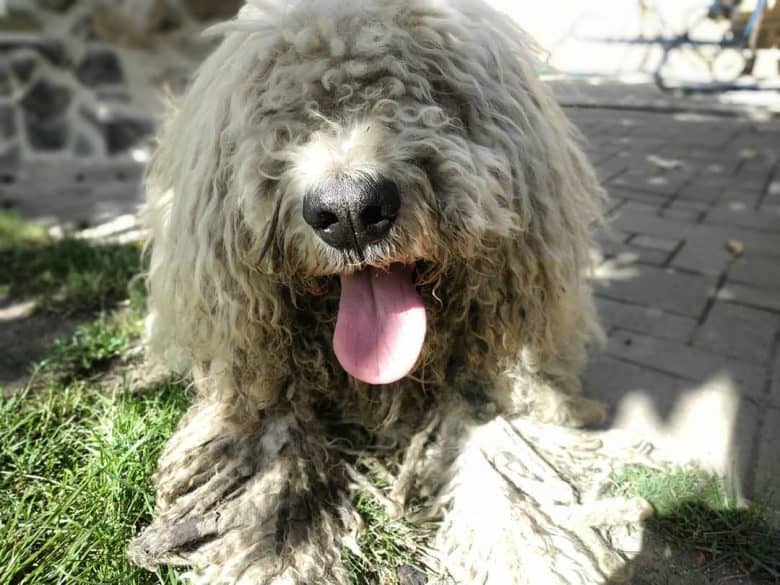
Komondors are incredibly loyal and will go above and beyond to protect their family. These dogs are affectionate and calm with children, but they can be fiercely protective of the little ones, too.
You should always monitor their interactions as their playfulness can innocently become a bit rough.
You’ll also need to be a confident leader in socializing and training the Komondors. Their domineering nature and assertiveness in situations make these dogs unsuitable to novice dog owners.
Komondors are intelligent with a high trainability level. They’re not lazy dogs as their sole purpose is to protect.
When training your Komondor, it’s important to be firm and consistent. Always use kindness and positive reinforcement training techniques. Obedience training is crucial for the Komondor to know who’s in charge.
Don’t use force when training your Komondor. Independent dogs will not respond well to this approach, so be patient, and avoid repetitive and boring tasks for a clever pooch like the Kom.
Nonetheless, Komondors do make for loving family dogs. They love to cuddle with their owners, creating strong protective bonds between them.
They’re known to follow family members from room to room to ensure their safety. You won’t find a better guard dog, especially if you live on a large land plot or a farm with livestock.
Are Koms aggressive dogs?
They’re generally calm and easy-going in typical settings. However, when trouble strikes, the Komondors’ aggression kicks in — fearlessly — defending their family against any perceived threats.
They’re also wary of strangers, often never feeling comfortable with people that are not part of the family. When bringing unfamiliar guests into the home, introduce them to your pet on arrival.
With that said, we recommend steering clear of highly social areas like dog parks. You wouldn’t want your pooch to attack anyone unfamiliar.
If you do have other pets, Koms usually treat them as members of the flock. Still, it’s best to know that they’re more accepting of cats and livestock than other dogs.
Socialization at an early age is crucial. Expose your Komondor to different people, animals, and situations as early as possible. This way, you can teach him the correct behavior when exposed to similar situations in the future.
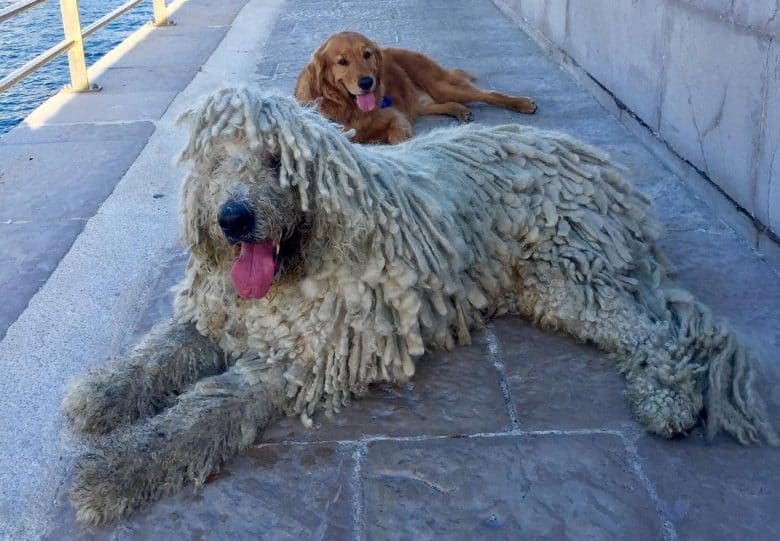
Given the fact that Komondorok are always on alert for danger, don’t be surprised by frequent barking. They have a loud bark which is another reason they’re better suited to country or farmhouses, away from close neighbors.
You can comfortably leave your Komondor alone for a couple of hours, preferably in a large yard or garden. This setup will not affect him negatively, given his independence as a guard dog.
All pets should still live indoors with their humans.
How do you care for a Komondor?
We’re not going to sugar coat it. Koms are high maintenance. Their coats need attention and care, and you will need to exercise them daily.
Although they can tolerate warm climates, these fluffy canines with dense coats will thrive living somewhere with cooler temperatures.
It’s a good thing that those thick, corded fur will protect them from extreme weather conditions and harsh elements.
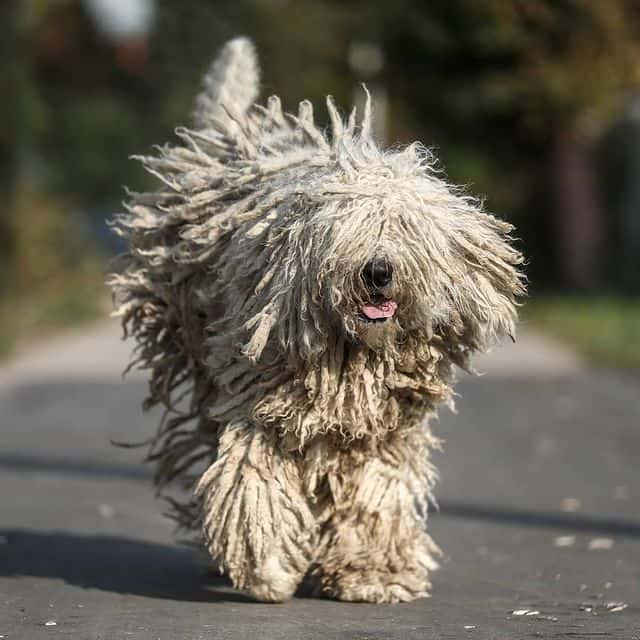
Exercise needs of the Mop Dog
Komondorok are moderately active dogs that only require 20 to 40 minutes of daily exercise. They’re always eager to run or walk.
Known for their ability to stick with a moving flock, Komondors can walk a decent mileage. We recommend trying for at least 10 miles a week when walking your dog.
Nonetheless, these dogs are happy to sit and lie around watching their family.
Grooming: Do Komondors shed a lot?
Komondors have a low-to-non-shedding coat. They’re not on the list of the most hypoallergenic dogs, but they’re still a suitable dog breed for people with slight allergies.
Keeping them in top-notch condition requires a lot of grooming. There’s no need to brush those tassels, but they do need special care in maintaining their unique coat.
Separate the cords on the coat frequently to prevent it from matting or trapping any excess dirt or debris. Do this daily or at least a few times a week to ensure a smooth and beautiful mop.
And as with any double-coated breed, it’s never a good idea to shave their fur. All that hair serves a purpose, and doing so will ruin the coat.
Bathing your Komondor may seem challenging, but it doesn’t have to be. Here’s an informative video on how to manage bath time with your giant friend:
Do Komondor dogs smell?
As long as they’re rinsed and dried well after every bath, this purebred won’t have a distinct odor. If the coat remains damp, it can get damaged and smell unpleasant.
How often you give your Komondor a bath will depend on his lifestyle. Show dogs and Koms who spend plenty of time outdoors will naturally need washing more often.
Bathing your Komondor excessively is not a good idea as this can ruin the naturally coarse Komondor dreads.
Komondor puppies still have very woolly coats, and the dreadlocks only begin to develop at around two years old. So upkeep of the puppy’s coat is easy to maintain, and bathing is not required as regularly.
For convenience, you may also contact a professional pet groomer from time to time.
Feeding: How much should a Komondor eat in a day?
The type and amount of dog food you feed your pet will depend on his body weight, age, metabolism, and existing health conditions. Generally, Koms require 3 to 4 cups of high-quality kibbles or about 2,000 calories daily.
To know your dog’s required daily caloric intake, you can use a dog food calculator.
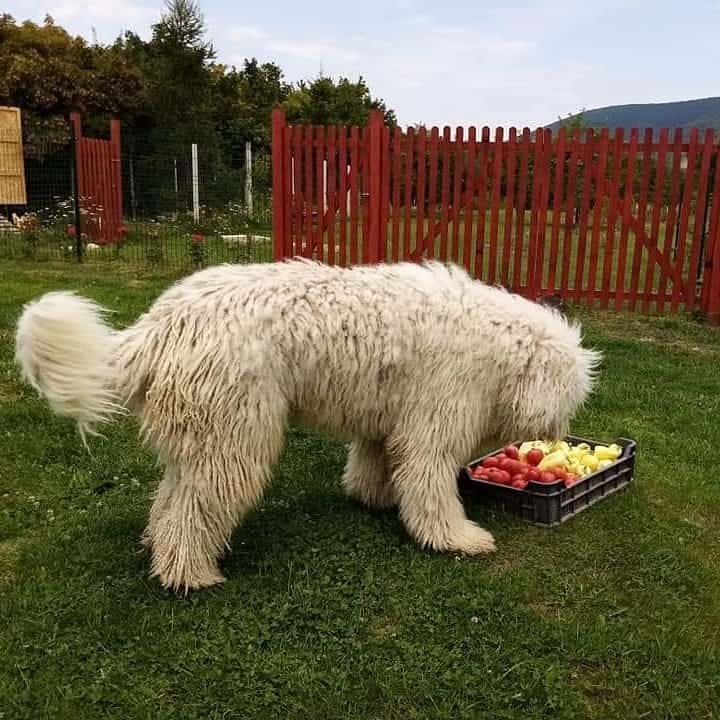
Koms are also prone to bloat or gastric torsion, and so it’s best to stick to a routine and help your dog eat better using a slow feeder. Do not leave food in his bowl to snack on whenever he wants.
What health problems do Komondors have?
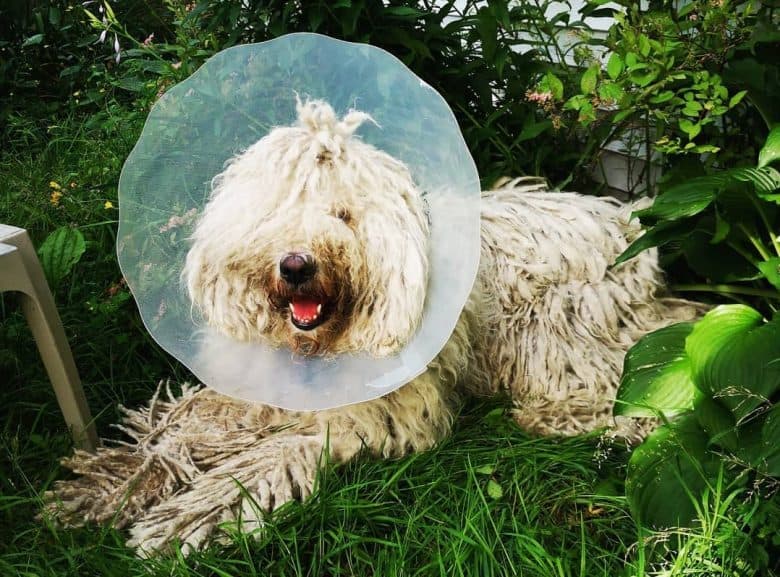
The life expectancy of Komondorok can reach 10 to 12 years of age. Some can exceed that lifespan, but what’s important is to take into account the health issues that they’re prone to.
Other than bloat, Koms can also suffer from illnesses like joint problems, eye conditions like entropion, and ear problems.
Hip Dysplasia happens when the hip joint does not develop fully, causing friction and painful movement.
Bloat or gastric torsion is the sudden enlargement of the stomach from eating too fast or too much.
This condition can be life-threatening, and if you notice your Komondor pacing or trying to vomit after a meal, then you should get him to a vet immediately.
Entropion is an inward eyelid problem described as the eye “rolling in” on itself, which can affect either one eye or both.
If you notice irritation around your Komondor’s eyes, it is best to have it checked out by a veterinarian as soon as possible.
Given that this breed is prone to hip and eye issues, we recommend that you take your pup for frequent hip and eye screenings. You can further check out the official health statement from the Komondor Club of America.
How much is a Komondor dog?
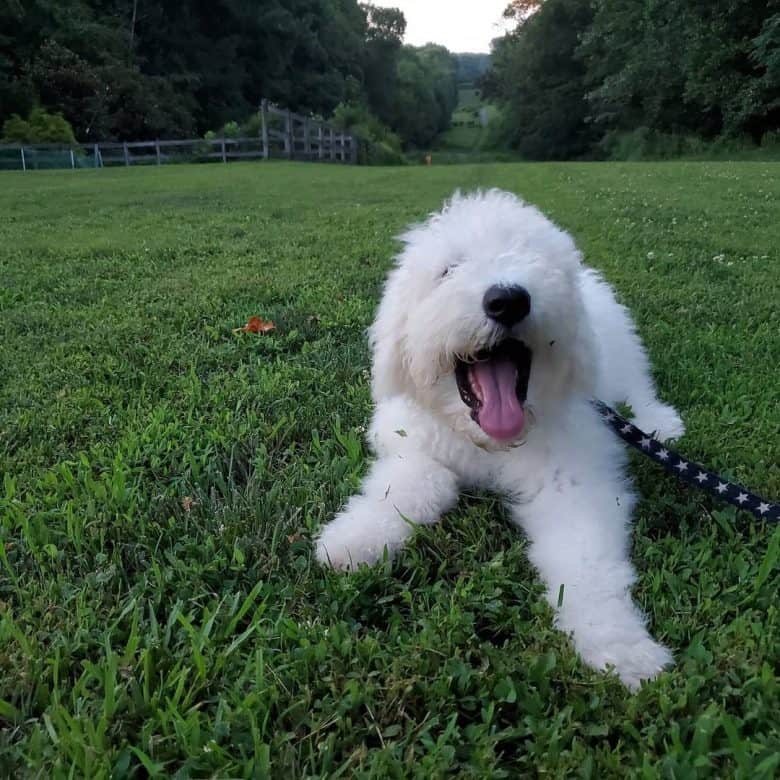
A Komondor puppy can cost anywhere from $800 to $1,200, with the average price around $1,000.
Some can still be more expensive depending on different factors like the pedigree, gender, the breeder’s popularity and location, and even the litter size.
Koms usually have 3 to 10 puppies, but if a litter has fewer pups, then each puppy can cost double.
This excludes all other expenses. As responsible owners, we need to think about whether everything from care, energy level, feeding, food, accessories, grooming, and trips to the vet is actually manageable for us in the long run.
Finding Komondor breeders
Komondors are rare in the United States, which means that there is also a scarcity of breeders. The Komondor Club of America is a great organization aiming to preserve and protect this one-of-a-kind breed.
If you decide to get a Kom for a pet, the organization also has a list of registered kennels with a solid reputation for at least five consecutive years.
You can also buy a Komondor puppy from the AKC Marketplace, California Komondor, and Mossy Falls Farm.
Komondor dogs for adoption
Adopting a Komondor as opposed to buying one is always a great idea. There are a few rescue spots in the US that often have Koms looking for forever homes:
- Komondor Rescue (Riverside, CA)
- Middle Atlantic Komondor Club Rescue (Glenmoore, PA)
You can also request an adoption form from the coordinator of the Komondor Club of America.
Komondor vs. Puli
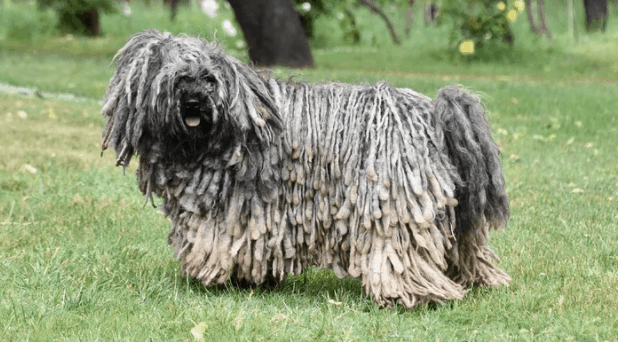
The Komondor and the Puli are similar in a variety of ways. They’re both purebreds that originated from Hungary and were initially bred as livestock guardians, meaning it’s in their nature to be protective watchdogs.
Temperaments are also the same. They’re intelligent, independent, and find great joy in guarding their humans. But Komondors are working dogs, while Pulik are herding canines.
Another notable difference between them is their coloring. Komondor’s unique coats are strictly ivory white, while a Puli’s coat can come in white, cream, brown, and black.
Don’t miss: What are the best working dog breeds?
The pros and cons of owning a Komondor dog
If you’re a confident alpha who can lead, train, and work hard with a Komondor from an early age, then this might be the dog for you.
Once trained, you’ll be blessed with a canine companion that will reward you with loyalty and protection.
For first-time dog owners interested in getting a Komondor dog, consider this fido’s high maintenance needs, such as grooming. Even their barking tendencies may make you rethink getting this pooch.
But if a challenge is what you’re looking for and you’re ready for it, a faithful and affectionate doggo will stand by your side fiercely.
What do you think about Komondorok? Share your thoughts with us! For Komondor owners, feel free to tell us about your experiences with your fido by leaving a comment below.