Saluki
Ancient Hunting Hound of the Middle East
Authors & Contributors
Jane Taylor, Khamsa Salukis and Arabians,
khamsa@earthlink.net
Sharon Walls, Obi-Wan Salukis,
saluqi@optonline.net
Lyndell Ackerman, Camp Carma Salukis
Catherine Meyers, Comelightly Salukis
Copyright 1994, 1995, 1996 by Jane Taylor and Sharon Walls.
How is the Saluki around children? Other pets? As a watchdog?
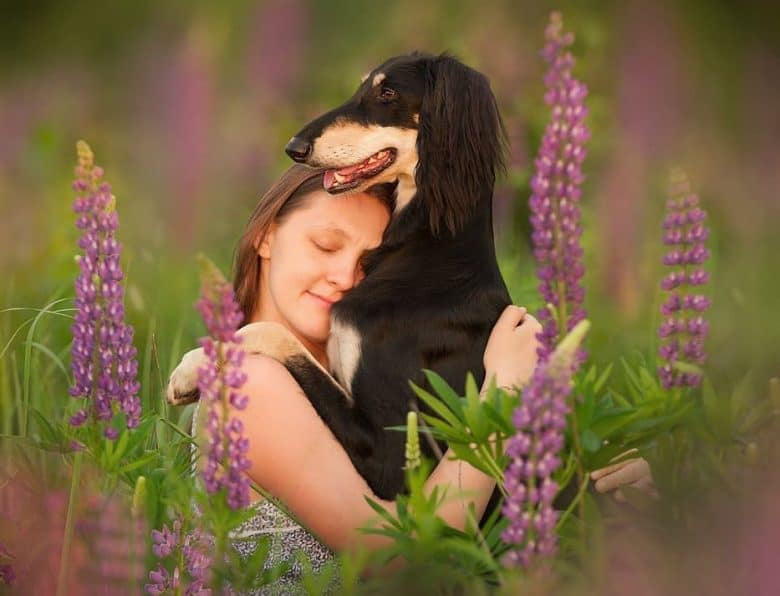
The Saluki can be quite tolerant of children and can be accused of
"licking the baby" too much. As with any breed the temperament of the
puppy in question can determine how it will interact with children.
Salukis can be territorial while claiming "their" children and
protecting them from a "Saluki-perceived" harm. They can be
protective of other pets in the household as well. In the Middle-East
they have been used as flock guardians. This does not mean that they
can be trained as watch/guard dogs like a Doberman or Rottweiler. It
is from the Saluki's sense of loyalty and companionship to their owner
that this tendency can be attributed. Salukis can be temperamental
and will become quite emotionally attached to their owners.
Are they noisy? Do they have any bad habits?
Salukis tend to bark only when there is something worthwhile to bark
at (unless one has fallen into bad habits out of boredom). They are
very athletic, easily able to clear high fences unless the owner has
taken proper precautions to see that this does not occur. They are not
usually nuisance diggers, but can create large pits to escape summer
heat if left out of doors. Also, if not exercised enough, your Saluki
may excavate your backyard and garden into W.W.II sized foxholes.
Is the Saluki a good house-dog?
The Saluki is an extremely clean dog with little to no odor, and
minimal shedding due to the short coat. In general, a Saluki kept
indoors sheds a little all year round. Salukis are not generally
thought of as outside dogs and they tend to not do well in that kind
of situation.
They do not drool, except in anticipation of food. They are generally
easy to house train. They will take over the furniture unless their
owners discourage this habit from puppy hood. A happily wagging tail
will easily clear off low coffee tables.
Many Saluki owners have learned the "seven foot rule"; if you don't
want the hound to get whatever the item is (butter on the counter,
leftovers on the stove, the roast thawing on the counter) put it out
of reach -- at least seven feet from the floor.
Are there any special feeding problems?
Some Salukis can be finicky in their eating habits and periodically
fast. Most Salukis eat less than other breeds of dog and drink less
as well. This is evident in Arabian horses and camels as well. One
of the most often heard questions by a Saluki owner is "Don't you feed
that dog? It's so skinny, I can see its bones." The answer is --Yes,
I do feed it. All that wants. It also runs approximately 35 mph.
Salukis and sight hounds in general have the smallest amount of body
fat of all the dog breeds. When spayed or neutered they may gain
weight and the coat may become fuzzy.
Are there any special medical problems?
Due to lack of body fat, Salukis are sensitive to anesthetic
agents. This is true of most, if not all, the sight hounds. They also
can have reactions and intolerances to some worming and flea products.
In particular, the wormer known as TASK is not recommended for use on
Greyhounds. As a general rule if the label states not recommended for
use on Greyhounds don't use it on a Saluki.
The #1 cause of death in Salukis is Hit By Car.
The #2 cause of death is Old Age (average life span 12-18 yrs).
Thyroid: Some Salukis may be affected by low thyroid function. This
can be detected by blood tests and can be corrected by oral
medication. This condition may be seen in older animals whose hormone
level has decreased, and also in neutered animals.
Cancer: Cancer has been reported at an increasing rate; many of the
animals affected have been at 4 yrs of age.
Heart Conditions: The Saluki is a tremendous athlete; if given the
opportunity to fulfill his hunting instincts, the heart may become
enlarged.
As with any breed, regular annual checkups and proper follow up with
diet and medication (if necessary) are recommended.
How much exercise does a Saluki need?
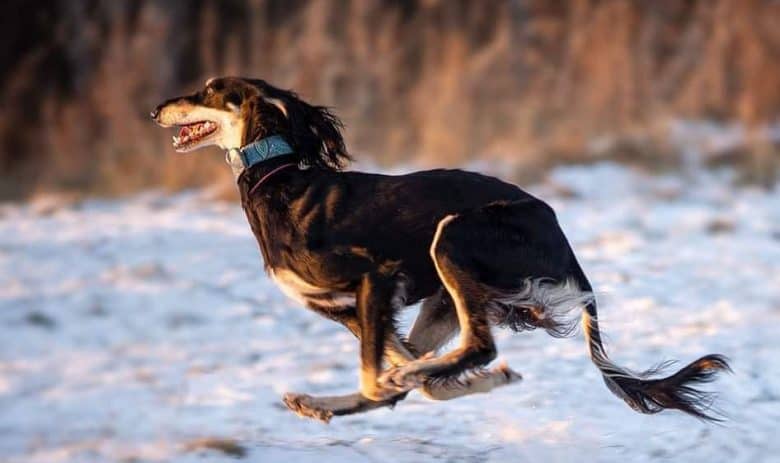
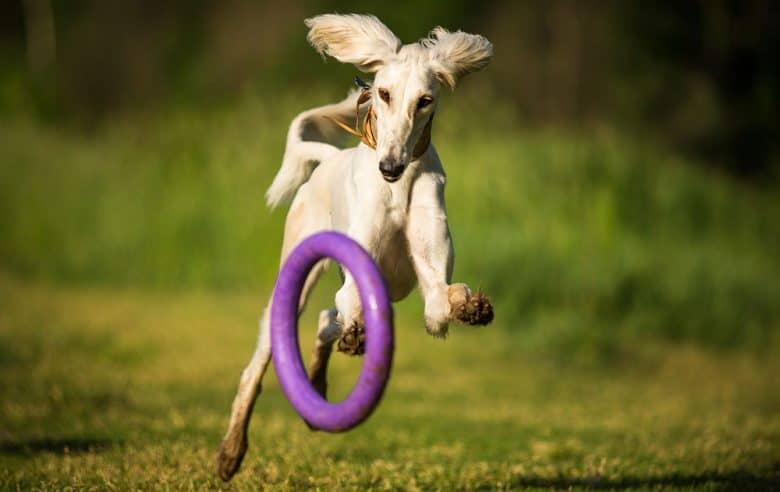
Salukis love to run. They will run just for the thrill of it. One to
two miles or more at a time. They can make excellent jogging
companions. In the Middle-East Salukis were and are kept by the
Bedouins, a pastoral nomadic people, and thus would travel numerous
miles over the yearly trek.
Are they energetic or hyper? Are they high-strung?
A young Saluki can be a very energetic fellow. In general, they mature
into lovely calm dogs. Salukis have an instinct to chase moving objects
and they can learn what is acceptable to chase and what is not. As a
general rule, at the age of two they begin to settle down and continue to
mellow significantly each following year.
What were Salukis originally used for?
Salukis were and are bred in Middle-East as a hunting/companion/guard
dog. They primarily hunt by sight, and to a much lesser degree by
smell, and thus are very aware of their surroundings. Salukis have
keen hearing, but when in pursuit of "game" exhibit "selective
deafness" (which is usually infuriating to the owner who is calling
their hound at the top of their lungs with no noticable result). When
the dog has stopped running and is standing still is the time to
attract the dog's attention by both calling it and making waving
motions with your arms. Their native quarry includes hare, gazelle,
and bustard.
This Saluki breed guideline listed below has been accepted and
approved as of May 10, 1994, for use in the evaluation of the Saluki breed at
International Middle Eastern Coursing Hound Association (IMECHA)
conformation shows. Additionally, it is supplemental information for use
in the conformational judging of Salukis at the International All Breed
Kennel of America, Inc. (IABKCA) and Alle Rasse Gruppe (ARG) shows. This
guideline was developed by the members of the IMECHA. IMECHA is the parent
Saluki breed group to IABKCA in association with the Union Cynologie
International e.V. (UCI) located in L”hne, Germany.
Breed History
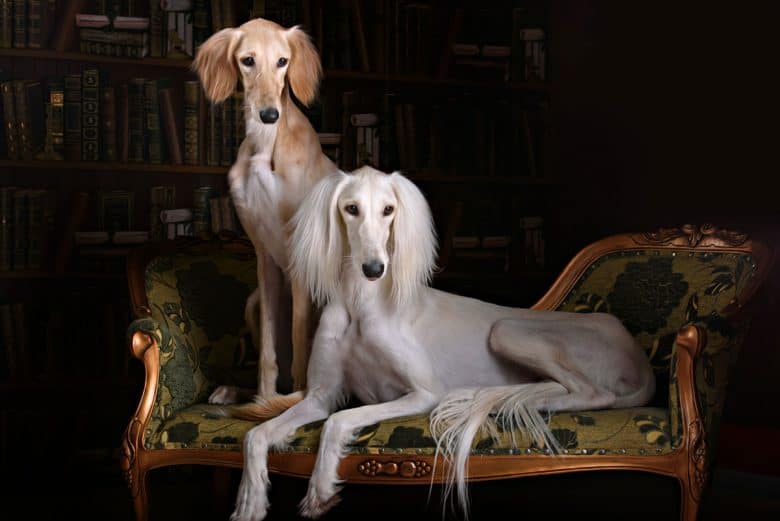
The Saluki is one of the most ancient breeds of hunting hounds.
Paintings of and references to Salukis have been found in ancient Egyptian
tombs, Sumerian buildings, and Assyrian temples. This places the age of
the Saluki, as a distinct and domesticated breed, at approximately 7,000
years and it has remained relatively unchanged to the present day. From
ancient to modern times the Saluki has been used to hunt gazelle, hare,
bustard (a type of bird), jackal, fox, and wild ass. The hunting style of
the Saluki is to sight and run the game down, catch and retrieve it. It is
a multi-game, multi-terrain coursing hound. In more recent times (the past
2,000-3,000 years) the Saluki has been kept by the nomadic Bedouin tribes
of the Middle East to hunt game animals to provide meat for the cook-pot.
With the advent of Islam, dogs were, and are, considered unclean beasts.
However, in the case of the Saluki an exception was made. By the Bedouin,
Salukis are considered the Gift of Allah to his children. They are allowed
in the tents and considered special companions. It has been said that the
Bedouin will never sell a Saluki, but will give one as a special and
precious gift.
The questions that might come to mind in regards to the Saluki are:
- What do the Bedouin look for in a Saluki?
- Why do the Bedouin want a particular look or type?
- What do the Bedouin consider good function?
- What types do different Bedouin tribes have and breed for?
- For what purposes are the different types used?
Most of these questions can be answered by studying the terrain,
climate, and game available in the various regions that Salukis are found.
It must also be kept in mind that Salukis do not have a "Country-of-Origin"
per se, but rather a "Region-of-Origin." Historically Salukis can be found
ranging from Iran, Iraq and Turkey in the North, throughout the Arabian
Peninsula in the South and East, and into Egypt and across North Africa in
the West. Interestingly enough, the overall picture of Saluki structure is
consistent throughout these areas with a wide variety of breed types.
In the following sections are points found to be consistent
throughout the region and can be interpreted as the "Region-of-Origin
Saluki standard," as well as Bedouin lore from the various sources listed
in the references. In considering the qualities listed throughout this
guideline: Imagine yourself at the edge of an Arabian desert where you
will be camped for three weeks. You have all of the general camping gear
you need but you food supply is limited to 55 gallons of water and 10
pounds of rice. Standing beside the tent are six Salukis, you have your
choice of three, two of one gender and one of the other. Keep in mind you
will use these Salukis to provide meat for your cook-pot as well as their
sustenance. Which ones do you feel can do the job that they were bred to
do; hunt by sight, run the game down, catch and retrieve it?
Breed Description
Overall Appearance
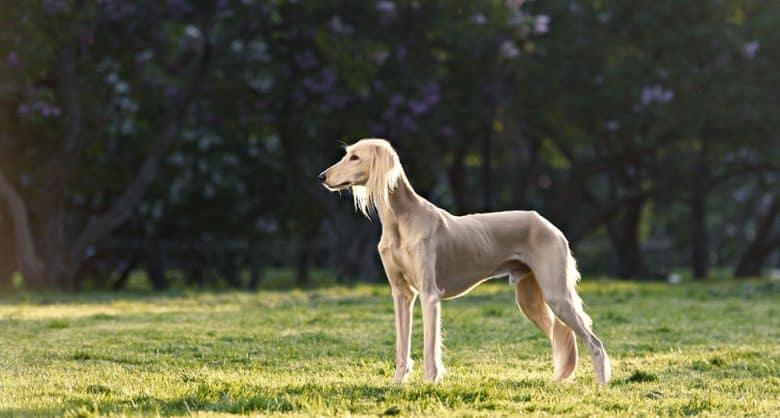
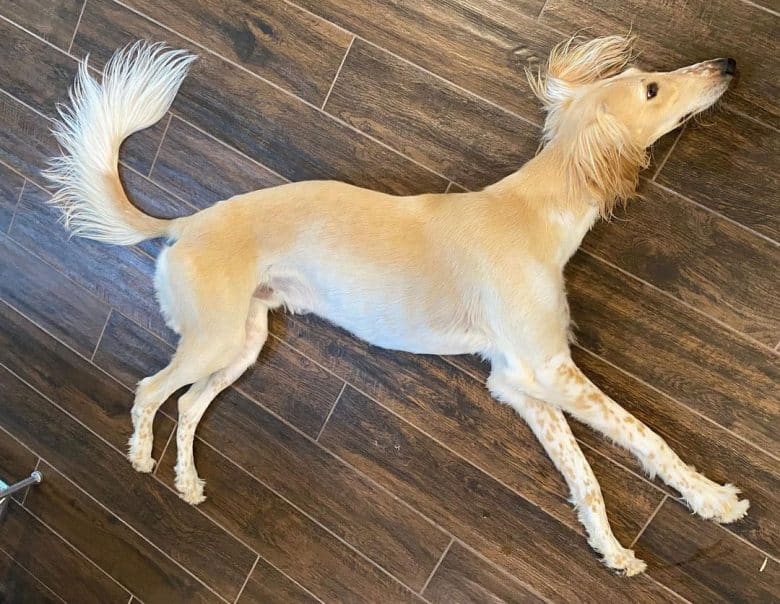
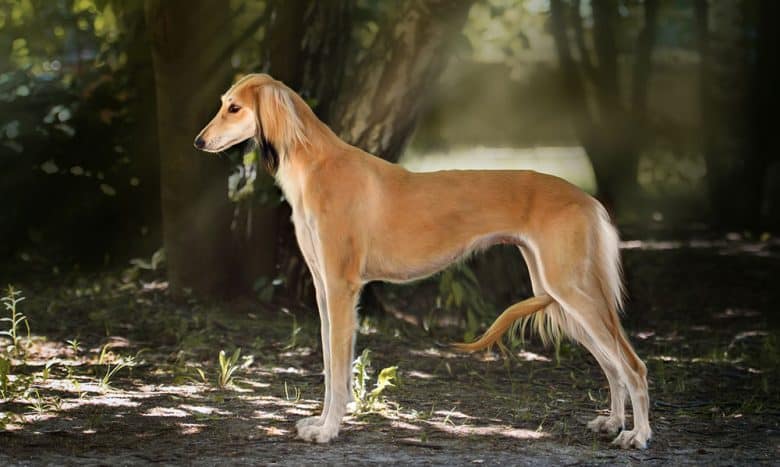
In the show ring the overall appearance of the Saluki is one of
grace, symmetry, and a well conditioned athlete. The impression given is
one of the ability to hunt and kill efficiently. While on the coursing
field the impression becomes a reality with the addition of an intense
desire, drive, and focus that is not seen in the show ring. Combined,
these qualities comprise undeniable Saluki breed type and function.
The Smooth Variety exhibits the same qualities with the exception
of feathering. In both varieties males may range from 23 to 28 inches at
the top of the shoulder with bitches measuring somewhat smaller.
Head and Face
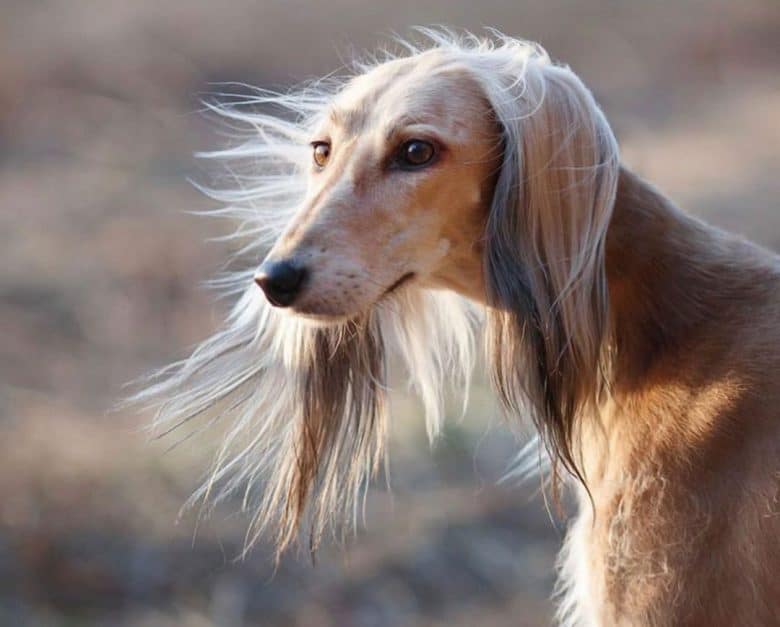
The head should be longer than it is wide for breed type. Wedge
shaped when viewed from above with adequate width of backskull for
attachment of the jaw muscles. This is for clamping power when making a
kill. In profile, the head will again be wedge shaped with a slight stop
at the eyes. The top of the skull should not be domed and be almost flat
(in keeping with the "wedge" shape). The eyes are almond shaped in the
Saluki and are set into the skull (not protruding/bulging) at a slightly
oblique angle to the face. The color can range from light honey to dark
brown. The set of the eyes and their lashes protect them from sand and sun
glare. The expression is that of a keen hunter. It can be said that the
Saluki will have a definite Eastern/Oriental appearance about the eyes.
Tribal Lore: The Bedouin prefer a lighter color to the eye. They say the
Saluki can see better and farther.
The bony ridges in the muzzle will provide for an appearance of
refinement and chiseling to the face. The tightness of the lips to the
cheekbones will give the appearance that the Saluki is smiling. The lips
should be close to the cheek and not drooping - a clean, dry mouth.
Tribal lore: At least five hair warts should be on the face -- two on each
cheek and one or more on the chin. However, two or three on the chin is
most desirable.
Pigment
Pigment of the nose is black to liver. In older Salukis a graying
in black noses may be seen. The eye rims in darker pigmented Salukis will
appear as if they have been painted with kohl (a kind of black makeup made
from antimony that Middle Eastern women use to define the shape of the
eye). Tribal lore: a mottled or pink nose is very undesirable as they
cannot stand the sun.
Teeth and Bite
The teeth must be strong and white with a scissors or level bite.
Full dentition is desirable. Tribal lore: The hound should have what the
Bedouin describes as laughing jaws for a powerful bite. When running, the
mouth will be wide open and the lips will be pulled back. It is this
action and the set of the jaws that are referred to as "laughing jaws."
Ears
The ear leather should be "drop-eared," also known as
"floppy-eared." The leather should be of sufficient length to reach the
corner of the mouth, but no so large as to hinder the hound while coursing
and catching game. The ears should be set high on the head, typically well
above the eye line. The ears are very mobile and will allow the ear
leathers to almost touch each other behind the backskull when pulled back
and up. Depending upon the Saluki's mood, the ears may also be held in
positions known as "airplane ears" (the ears will resemble a set of bent
airplane wings due to a fold in the leather and alert positioning), "mouse
ears" (the ears are pulled up, as if to touch over the crown, and forward
framing the face; a very alert and inquisitive position), and "rose ears"
(the ears are folded, pulled towards the back, and held next to the head
similar to a Greyhound's). The texture of the feathering must be silky
(quantity is not important). This feathering is absent, of course, in the
smooth variety with the exception of short to moderate length guard hairs
sometimes called "lashes." A few of the Bedouin tribes would crop ears.
This practice is more common in the northern areas, particularly among the
Kurds. Cropping was done for a variety of reasons: to prevent the ear
leather from being torn while hunting predatory game such as jackal and
fox; for beauty; for protection against damage from thorn bushes; for
identification (cutting only one ear or only part of the leather); for
speed; for alertness. Some Salukis imported from the Middle East have had
cropped ears.
Neck
The neck should be moderately long, supple, and well muscled. The
throat latch (the area where the head and neck join) should be fine for
mobility of the head in making the catch of game.
Front Assembly
The chest at the heart girth should be deep and with sufficient
width (spring-of-rib) for endurance in the chase. When viewed from the
front the chest bone (sternum, a.k.a. keelbone) and points of the shoulders
should be visible, while the area below them (the forechest) will be
somewhat filled in. Tribal lore: Belief is that if the width is too wide
(barrel chested) the Saluki will lack speed. If the width is too narrow
(slab sided) the Saluki will lack endurance.
The forechest should be moderately narrow in proportion with the
size of the Saluki. This is for speed. The width is linked with the
placement of the shoulders on the body, i.e. too far forward can create a
"narrow front," too far back can create a protrusion of the sternum several
inches beyond the points of the shoulder known as "pigeon breasted." Keep
in mind that a balance between "spring-of-rib" and the placement of the
shoulder assembly creates the proper width. It has also been observed
that when while moving on harder terrain a looseness in the front assembly
may appear. However, this looseness will disappear when the hound is
moving on loose sand. Thus, the front assembly is compensating for the
movement of the sand under the Saluki's feet and there is a purpose to the
looseness.
The forelegs should be straight and long from the elbow to the
wrist with a slight slope in the pastern to the foot. The pastern must
also be strong. The slope and strength of the pasterns is for shock
absorption while running as the wrist can be hyperextended at almost a 90
degree angle when the foot is in contact with the ground and the front
assembly is in follow-through from extension to flexion. A slight
toeing-out of the foot is not uncommon. The bone of the limbs is oval
tending towards bladed (not round in appearance as in a working dog) with
fine quality, however it is very dense and strong for its size. Like the
Arabian horse, Salukis possess subtle power and strength.
Feet
The foot should be shaped as the foot of the hare (two middle toes
longer than the outside two); this applies to both front and rear. The
rear, however, will be slightly less noticeable. Tribal lore: The
feathering between the toes and pads is for protection against the hot
sand. Some Bedouin will apply a henna pack (a dried and crushed plant
mixed with water) to the Salukis' feet; this is to toughen the pads against
cuts and abrasions during a hunt or trek. The henna pack will typically
extend to slightly above the wrist on the front legs and almost to the hock
on the rear.
Back and Loin
The back should be well muscled with an unmistakable arch over the
loin. A good arch lends itself to muscular conditioning more than skeletal
structure. It should be noted that the length to height ratio can vary
from region to region. In the more northern areas the Saluki can measure
slightly longer than tall. While in the southern regions this measurement
can reverse itself, more tall than long. In addition, a more square
variety can be found throughout. In other words, the measurement from the
top of the scapula (shoulder) to the ground typically equals the length of
the dog as measured from the point of the shoulder to the point of the
rump. Each variation can have its advantages on the coursing field: more
long than tall can be better over mountainous terrain, more tall than long
can have greater sprint speed, and a more square Saluki can have better
endurance and speed on long courses. All are correct in keeping with breed
type. The waist (tuck up/loin) should be pronounced. Tribal lore: The
loin should be no more than what a man can grasp around with his hands
(thumb to thumb and second finger to second finger). The males will be
slightly bulkier than the female, but over all the fineness applies to
both. This is for greater speed.
Rear Assembly and Angulation
The hip bones should be prominent. When viewed from the rear the
croup should appear to have a trapezoid shape. When the hound is standing
naturally, the rear quarters should be higher than the fore (the arch in
the loin will add to this height) -- this height is due to the rear length
of leg and is for springing ability and length of stride. Tribal lore: A
man should be able to place four fingers between the hip bones. This will
show the agility and speed ability of the hound.
The 1st and 2nd thigh should be moderately long and well muscled
with the hocks moderately low to the ground in relation to the length of
the thighs. The whole showing moderate angulation in balance with the
forequarters. When standing in a show-stack position, the tips of the toes
on the front feet will be in a plumb line with point of the shoulder and
the front edge of the hind toes should be in a plumb line with the point of
the rump (the point of the ishium on the pelvis) and the hocks should be
perpendicular to the ground. This overall moderation of angulation is for
endurance, agility, and speed.
Tail
The tail is set low on the croup and carried in a curve. When the
Saluki is in motion the tail may be carried in a low curve, elevated curve,
or up and curved over the back (gay tail), but it should not be carried
without a curve i.e., straight up, straight out from the back, or hanging
limp --straight down. In the feathered variety the hair on the underside
of the tail is silky, not bushy. The smooth variety can range from a
shorter brush like feather (not bushy) to a short smooth coat. Tribal lore:
The tail should be of sufficient length to come between the rear legs, up
around the loin and touch the spine.
Movement
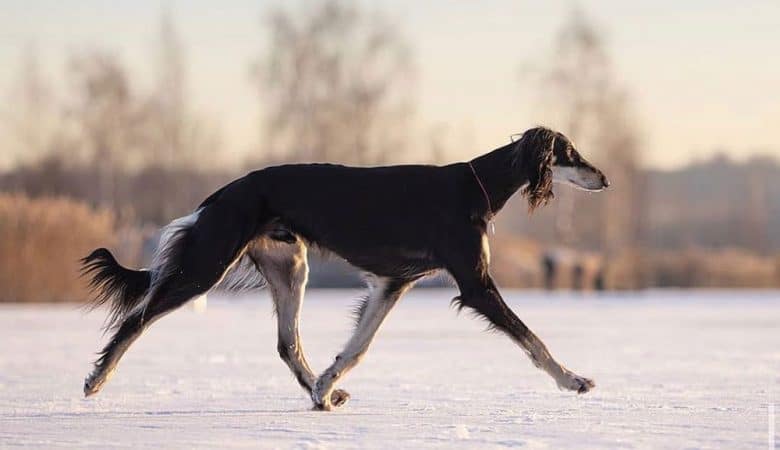
The working gait of the Saluki is a double suspension gallop (all
four feet are off the ground in flexion and extension) and they are
considered the endurance runner of the dog world. In peak condition the
Saluki can attain speeds of 35 to 40 miles-per-hour and keep it up for up
to five miles in pursuit of its quarry.
The double-suspension galloping style will give the appearance of
the Salukis' body flying over the terrain with no wasted motion and
appearing almost effortless. In addition, the head will be almost level
with the spine as will the tail. Both will have a small amount of pumping
motion as the Saluki's body is flexed and extended. In the flexed position
the spine will be curved so that the rear legs will be brought forward to
the point of almost being in front of the shoulder assembly. In extension,
the front and rear assemblies are almost level with the spine. The
double-suspension gallop is unique to the Saluki and other sighthounds and
is the only time when reach and drive will be exhibited.
Movement at a trot can give the appearance of floating over the
terrain (another appearance of effortless movement). This can be almost a
prancing type of step with the head up and the tail carried higher than or
at the level of the back. This type of movement is generally seen in play
or courtship and it can also be displayed in the show ring and it is not a
hackney gait. Movement with the head and tail at an lower level-more in
line with the spine-and the legs moving so that the feet are closer to the
ground is used for traveling miles. In other words, trotting with no
wasted effort - a conservation of effort/energy. It can be seen that when
a Saluki moves in such a manner it will single track - the feet will move
closer together almost as if they are converging along a line one foot in
front of the other. Also, when walking at ease the Saluki will frequently
walk a few steps with a movement resembling the camel's - a pace, the
right fore and hind move together and left fore and hind move together.
All of these types of movement are correct. Soundness in Saluki movement
refers to it being free from injury, disease or lameness. It must be kept
in mind that a Saluki is bred for hunting at a gallop and movement at a
trotting gait will not indicate how it runs. The most important points to
consider in all forms of movement are balance and moderation. Only when
these are present will the desired effortlessness-in-movement appear.
Coat Texture and Colors
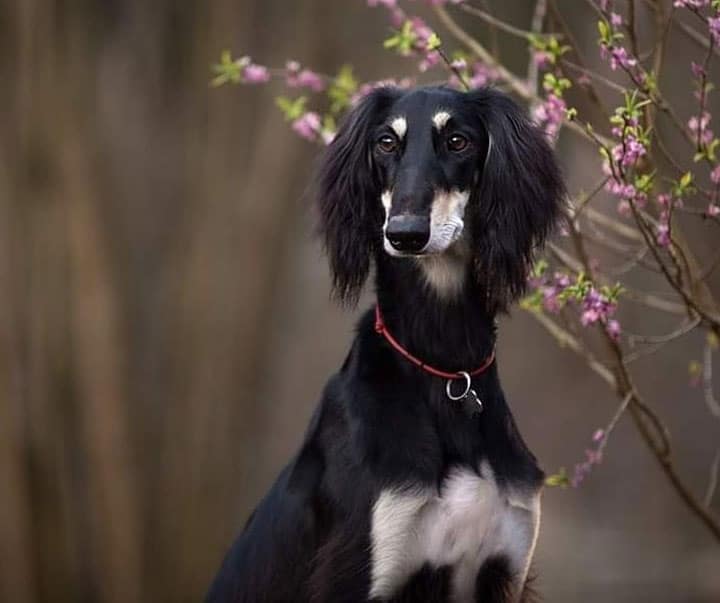
Coat texture is smooth and silky. Woolly feathering on the
shoulders and thigh may also be present. Puppies have a tendency to have
body wool as well. All colors are acceptable. Tribal lore: Generally the
Bedouins are not concerned about coat or colors as these do not influence
speed, stamina or hunting skill which are the main criteria for judging a
hound's qualities. However, through the years the following have come to
be known among Saluki fanciers as alleged Bedouin lore special markings and
their meanings: A small patch of white hairs in the middle of the forehead
is called "The Kiss of Allah." This Saluki is blessed and is very special.
-- A small patch of white hairs low on either side of the neck is
considered "The Thumb Print of Allah " and marks the Saluki as especially
blessed. (This mark can also appear as a small indentation in the
musculature along the forward edge of the scapula; this also appears in
Arabian horses). -- A white streak on the neck along the spine, as opposed
to a white collar marking, is called a fast mark and indicates that the
Saluki will be an excellent courser. -- A white tipped tail means that
the Saluki will be an excellent hunter.
Temperament
Salukis are known for their aloofness with strangers, regal
bearing, and apparent farsightedness. However, with their own family or
someone that they know, they can be outgoing and affectionate companions.
The Saluki has not only been bred by the Bedouin as a hunter for thousands
of years, but as a beautiful, elegant, intelligent, loyal companion, and
protector. Their native intelligence can be quite remarkable and they can
think their way through situations if given the opportunity. Salukis know
their own kind (meaning sighthounds in general and Salukis in particular)
and can have little tolerance for other breeds of dogs. In addition, they
can be protective of their families and friends (in the Mid-East they are
sometimes used to guard the home/tent). The Saluki temperament does not
lend itself well to kennel situations or heavy handed methods of training.
Salukis can be quite sensitive and become emotionally attached to their
owners. In the obedience ring, they tend to not do as well as other breeds
because they can be easily bored. However, if a strong bond with their
owner is evident they will do what is asked of them to please him or her.
Like the Arabian horse, they can be a friend and companion with undying
loyalty. However, due to their level of intelligence, this loyalty is not
linked with unquestioning obedience.
In the show ring, due to the Saluki's aloofness with strangers and
seeming farsightedness, it is not unusual for them to tend to draw away
from a strange hand reaching for their head or face. This is the exception
rather than the rule and they should not be penalized for this response.
In addition, Salukis should be approached from the front, with slower
movements. However, aggressive or vicious behavior should not be
tolerated.
Other Information and Considerations
It has been noted on the coursing field that when a Saluki has lost
sight of the quarry it will leap or "spy-hop" in an effort to become
sighted again. This is very similar in appearance to a gazelle leaping
while running (jumping or springing with all four feet at once). This
spy-hop, or "sproink" as it is sometimes called, can be as high as seven
feet and is a hunting characteristic of the Saluki.
Comments and References for Guideline Development
The books and publications listed below delineate what some Bedouin
tribes look for not only in Salukis, but their horses and camels as well.
All of these species have been bred to exist under inhospitable conditions
for thousands of years and the Bedouin have developed specialized breeding
formulas for optimum survival. The consistent points that can be seen in
the Bedouin programs for the Saluki, Arabian Horse, and Dromedary Camel are
the elegance, grace, symmetry and beauty possessed by each; one is just
larger or smaller than the other. In respect of the Bedouin's long history
and the original purpose of the breed, one should not presume to try to
improve upon what they have already perfected; breeding goals should
emphasize the preservation and maintenance of the high standards the
Bedouin have attained.
American Kennel Club, The Complete Dog Book , 17th edition., New York, NY,
Howell Book House/Macmillan Publishing Co., Saluki standard submitted by
the Saluki Club of America and approved in 1927, [1985]
Ash, Edward. C., Dogs: Their History and Development , Volumes I and II,
London, England, Ernest Benn Limited, [1927]
Brown, William Robinson, The Horse of the Desert, Nachdr'd. Ausg. New York
[1929], Hildesheim ; New York : Olms, [1977]
Copold, Steve, Hounds, Hares & Other Creatures: The Complete Book of
Coursing, Arvada, CO: Hoflin Publishing, [1977]
Daumas, Melchior Joseph Eug ene, The Ways of the Desert, 9th edition,
revised and augmented with commentaries by the Emir Abd-el-Kader;
translated from the French by Sheila M. Ohlendorf. With a foreword by
Robert A. Fernea, Austin, TX, University of Texas Press [1971]
Dickson, H. R. P., The Arab of the Desert - A Glimpse into Badawin Life in
Kuwait and Sau'di Arabia, London, England, George Allen & Unwin, Ltd.,
[1949]
Ferdinand, Klaus, Bedouins of Qatar: a study of the two Bedouin tribes in
Qatar. New York, NY, Thames and Hudson Inc., [1993]
Hutchinson, Walter, Hutchinson's Dog Encyclopaedia, London, England,
Hucthinson & Co., Ltd, [1934]
Miller, Constance O., Gazehounds: The Search for Truth, Wheat Ridge, CO,
Hoflin Publishing, Ltd., [1988]
Raswan, Carl, Black Tents of Arabia (My Life Among the Bedouin): Folcroft,
PA, Folcroft Library Editions, [1977]
Waters, Hope and David--Burydown Salukis--England, The Saluki in History,
Art and Sport , New York, Taplinger Pub. Co. [1969]
Watkins, Vera H.--Windswift Salukis--England, Saluki, Companion of Kings,
New enlarged 3rd edition., Hagerstown, MD : Copper Beech Press, [1995]
American Kennel Club, Canadian Kennel Club, FCI, Kennel Club of Great Britain,
Israeli Kennel Club, UKC, Rare Breed Kennel Club, States Kennel Club,
UCI - International All Breed Kennel Club of America, Inc.
For the local Saluki breed club in your area the American Kennel Club
in Raleigh, NC generally has a listing of breed clubs and their rescue
organizations from which you may be able to obtain a Saluki "in need
of a good home."
Saluki Club of America
AKC Parent Breed Club
Diana Farmer, Secretary
http://www.salukiclub.org/
American Saluki Association
Susan Demusz, Secretary
40311 Eureka Rd.
Magnolia, TX 77354
281-356-2546
STOLA - Saluki Tree of Life Alliance
http://www.stola.org/
If you are unsure about who in your area to contact, please e-mail
Jane Taylor or Sharon Walls (e-mail addresses at the beginning of the
FAQ). This FAQ will be updated periodically with new publication and
club information.
Saluki FAQ
Jane Taylor,
khamsa@earthlink.net
Hosted by
online lexapro prescriptions
low cost levitra
ordering lexapro online
cheapest price for levitra
ordering viagra
buying cialis on line
lexapro pharmacy indian
viagra india
fast delivery generic cialis
levitra no prescription
low cost lexapro
sales of levitra
buy cialis 20 mg
wholesale cialis
cheapest price for levitra