Though they’re not as popular as their Golden cousins, Flat-Coated Retrievers, also called Flatties or Flat-Coats, are worth the attention and affection.
With their cheerful and eager-to-please attitude, they’re absolutely a great fur buddy to have!
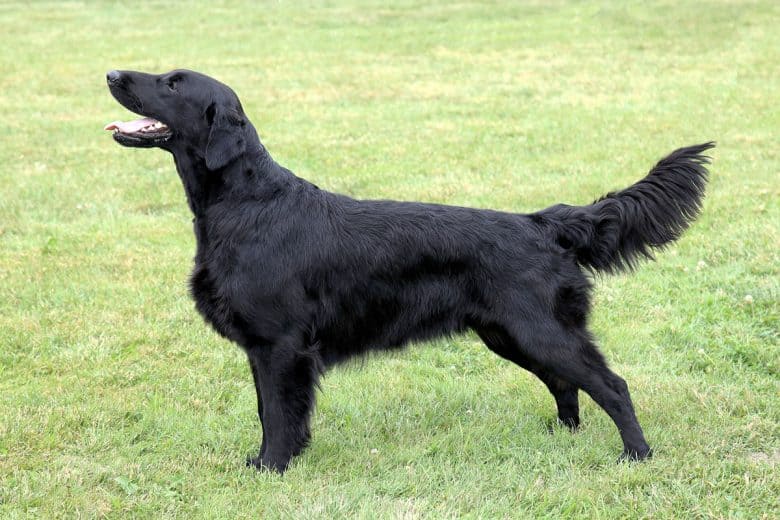
Ready to meet the Peter Pan of AKC’s Sporting Group? Keep scrolling and find out if you should add this retriever breed to your household.
The Flat-Coated Retriever at a Glance
We’ve put together a table below to give you a quick overview of the Flat-Coated Retriever.
| Breed Summary | Flat-Coated Retriever Quick Facts |
| Group | Sporting Group |
| Breed Purpose | Water Retriever Dog |
| Breed Size | Large |
| Height | 22 to 24.5 inches (56 to 62 cm) |
| Weight | 60 to 70 pounds (27 to 32 kg) |
| Coat Type | Medium, Smooth, Straight, Flat; Slight waviness is permissible |
| Shedding | Moderate |
| Most Popular Coat Colors | Black, Liver |
| Lifespan | 8 to 10 years |
| Temperament | Cheerful, Friendly, Playful |
| Energy | High |
| Exercise Needs | 2 hours |
| Average Price | $1,500 to $3,000 |
Where did the Flat-Coated Retriever originate?
Once called Wavy-Coated Retrievers, Flat-Coats are one of American Kennel Club’s (AKC) six retriever breeds and are gundogs of relatively recent origin.
It is said that they were first bred in Britain around the mid-1800s to retrieve game on both land and water.
But anyone who loves retrievers would know that they were initially used by fishermen to help them in retrieving objects and fish from the water, specifically around Newfoundland’s cod fisheries.
As firearms developed and became more advanced, hunters needed a canine that can mark fallen birds and return it to them without any damage.
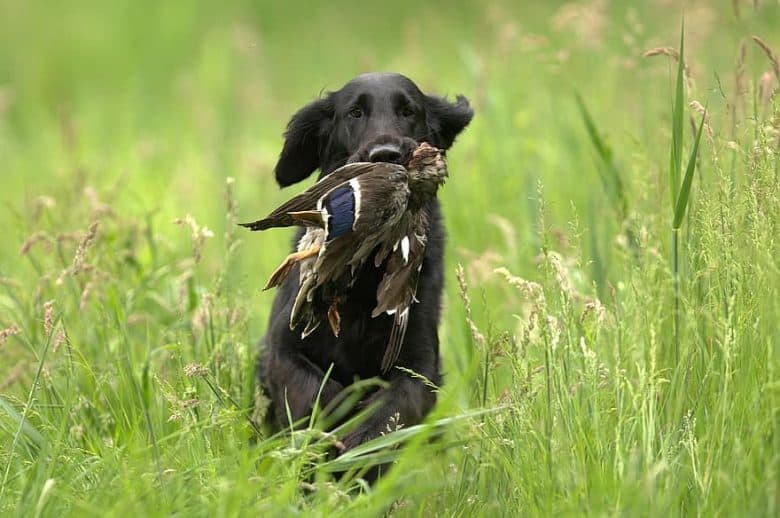
So aside from having the genes of St. John’s Dog that makes them natural retrievers with a soft mouth and unrivaled swimmers, these fishery dogs were crossed with early British breeds such as pointers to hone their bird-sense better.
By the end of the 1800s, the breed was developed from having a wavy coat that wasn’t water repellant enough to straighten hair.
Various collies, setters, spaniel-like dogs, sheepdogs, and Newfoundlands have also been included in the Flat Coat’s lineage, which is why they were called “mongrel” for many years.
Flat-Coated Retrievers were once known as the “Game Keeper’s Dog” because of the English gentry’s widespread use of this breed on their sprawling estates.
H.R. Cooke is the most famous patron of the Flat-Coat. He kept them at Riverside Kennel for over 70 years! It’s where any dog breed in awards, quality, and number has won in dog shows and field events.
Fun fact: The Flat-Coated Retrievers forebears’ name is based on their nature — Old Bounce and Young Bounce. Gamekeeper J. Hull owned them in 1864, and they were members of his working strain of retrievers.
Let’s not forget to give credit to S.E. Shirley. He helped mold and develop Flat-Coats into a stable type.
Another name that needs to be known is one of the greatest authorities on the breed — Stanley O’Neill.
He showed selfless devotion in ensuring that Flatties had a sound footing while advising new patrons of the 19th century of the correct type in building stock.
Unfortunately, they lost their top spot for popularity with the Golden Retriever and Labrador Retriever in 1918. By the end of World War II, they almost went extinct when registrations decreased to dangerous levels.
What does a Flat-Coated Retriever look like?
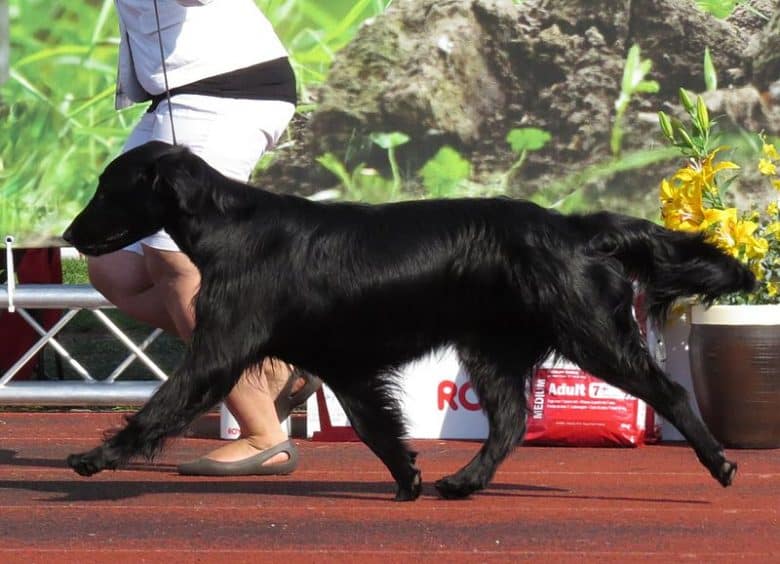
Just by looking at this fido, it’s understandable how some can mistake them as a brown or black Golden Retriever, but just to set things straight, there is NO such thing.
According to the AKC breed standard, purebred Flat-Coated Retrievers have a long, rectangular build with a silhouette that shows their elegant and lean look, which is evident in their stature and gives them a smooth, efficient, and ground covering gait.
Did you know that there’s a traditional description for them? It’s “Power without lumber and raciness without weediness.”
Flat-Coat also has a long or “one piece” head – a retriever’s distinctive hallmark, projecting their kindly and smart expression.
Adding to their sweet, puppy-dog-face are almond-shaped eyes that can either be brown or hazel and small, naturally floppy ears that are thickly feathered.
Size: How big is a Flat-Coated Retriever?
Flatties can stand as tall as Labs, but they’re leaner.
Flat-Coated Retrievers can weigh around 60 to 70 pounds (27 to 32 kg) and stand at 23 to 24.5 inches (58 to 62 cm) at the withers, where females are less taller with a height range of 22 to 23.5 inches (56 to 60 cm).
So if you live in an apartment and you’re interested in getting a Flat-Coat, think again. Aside from being a large canine, this pooch requires room to run and play.
In fact, they’re suitable for suburban- or country living.
But a home with a spacious yard that will give this doggo a chance to play and roam outdoors is good, too.
The double-coated Flat Coat
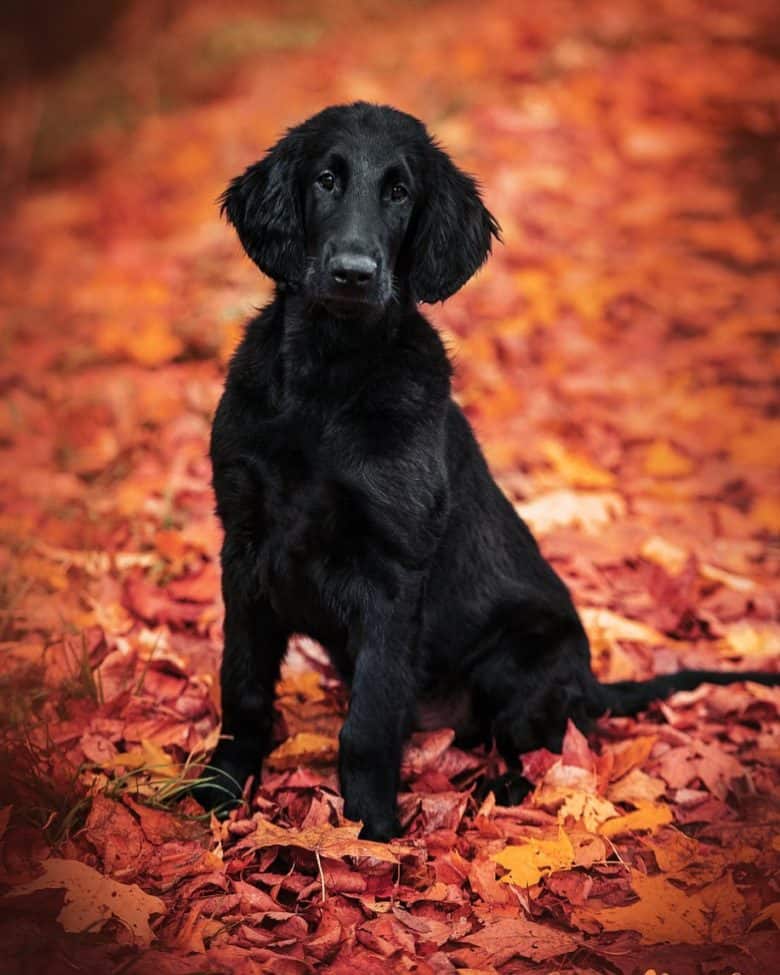
As a bird dog, the Flattie’s thick coat of moderate length is highly functional without adding weight.
Just like other breeds with a double coat, their fur protects them from the icy water, punishing ground covers, and harsh weather conditions.
Their good-looking coat shouldn’t be excessively long, but they naturally do have feathering on the chest, ears, the front and back of their forelegs, on their things, and underside of the tail.
Males have a heavier and longer coat around their neck.
Have you seen someone selling a yellow Flat-Coated Retriever? If yes, then you should steer clear of them. This breed ONLY comes in a lustrous black color or solid liver (a deep reddish-brown shade).
Temperament: Are Flat-Coated Retrievers good family dogs?
Flat Coats are sweet and exuberant, making them excellent pets. Still, we want to be clear that no dog is for everyone.
Do you know why they’re tagged “Peter Pan”? It’s because they mature slowly. Some owners even attest that even as adult dogs, they retain their puppyish behavior.
There are fans of the Flat-Coated Retriever that will find this trait delightful, while others will realize how exasperating it can be to tolerate such antics.
We recommend Flatties for active families with older children. It’s just not a good idea to have an exuberant canine who’s considered a champion tail-wagger to be around little kids and fragile people.
But with the right owner and family, this highly affectionate, friendly, and tolerant pooch will be a great companion for humans and existing household pets.
If you have another dog, don’t worry. With proper training and early socialization, Flat Coats will enjoy their company.
This can be bad news for some households, while some paw parents can actually tolerate this quirk. Either way, we recommend a rowdy and exuberant canine to families with older children.
You wouldn’t want your Flattie’s exuberance causing issues, nor their frequently wagging tail knocking over small kids and fragile senior citizens, right?
But we couldn’t blame a dog for their love of roughhousing and not knowing their own strength, so keep this in mind.
They are affectionate and cuddly, and they love to be near their people. With appropriate exercise and training, you can feel comfortable leaving them alone.
However, they crave companionship. Having a Flattie spend most of their time alone would be cruel.

These beautiful dogs are a gregarious breed and should never be shy or aggressive. They’re very good with other dogs, and they can live with cats and other animals in the home without issue.
The Retriever does bark when excited but isn’t known as a loud breed. They may bark to alert you of an outside presence and can be protective of their family, but they aren’t guarding dogs.
Their gentle, biddable nature makes them excellent candidates for service canines.
They are high energy working dogs designed to have the endurance for a full day of hunting. A stroll around the block is unlikely to satisfy their activity level.
They are the perfect companion for a hunter but can be very content in an active household. You’ll also find that they’re also always up for an adventure and are great hiking partners.
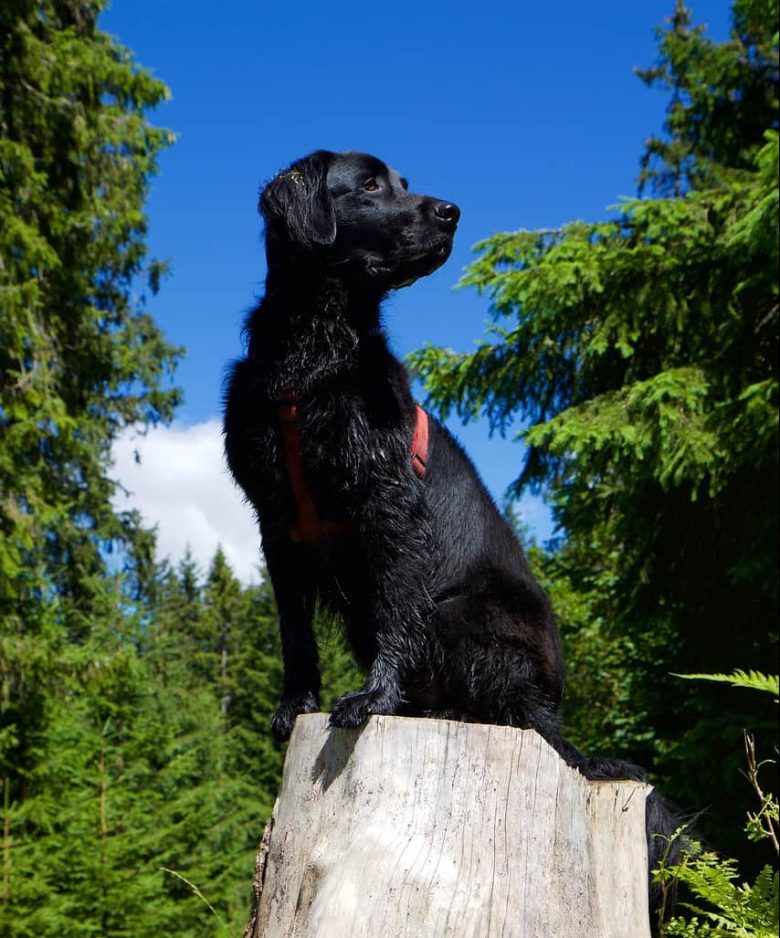
You’ll be glad to know that when it comes to trainability, Flat-Coated Retrievers are responsive because they’re intelligent and people-pleasers.
They will need interactive training full of mental stimulation. For experienced dog owners, we can say that they’re relatively easy to train despite their willful streak.
Be careful during training, though. Flat-Coats will test your patience due to their puppyish antics, but you should know that they’re very sensitive canines.
Avoid treating your pup harshly as it can lead to stubbornness or being unresponsive altogether.
No matter what, stick to fun training methods that keep your dog engaged while incorporating positive reinforcement. All kinds of doggy snacks, praise, and play will keep your Flat-coated Retriever stimulated and with a wagging tail.
After all the puppy classes, early socialization, and obedience training, you can expect a Flat-Coated Retriever to serve as therapy dogs.
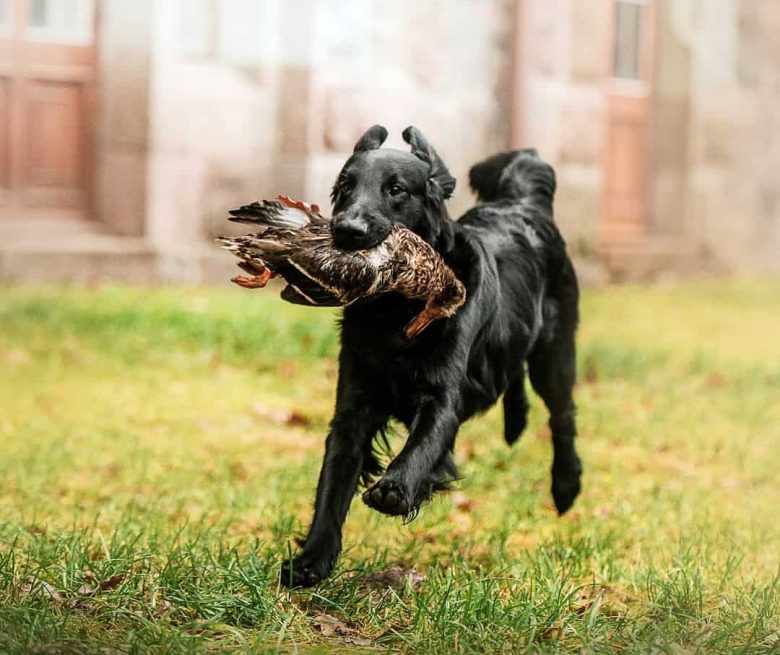
You can also have him join different canine sports such as rally, tracking, high-level agility competitions, and even dock-diving.
How to Care for Your Flat-Coated Retriever
Did you know that Flat-Coated Retrievers are highly sensitive to heat because of their liver or black coloring?
Even if it’s just warm, this pooch can overheat quickly, which is one of the reasons you shouldn’t leave your Flattie to live or stay outdoors for a long time.
Watch out for any signs of heatstroke as your Flat-Coat will not know if he’s getting too hot when playing outside.
So what else do you have to worry about when caring for this hunting dog?
Grooming: Does a Flat-Coated Retriever Shed?
Yes, they do. Flat-Coats are considered heavy shedders, especially when the seasons are changing. Not unless you have allergies, don’t be discouraged. Believe it or not, this breed’s hair is fairly easy to maintain.
Flat-Coated Retrievers require weekly brushing to remove loose or dead hair, dirt, and to distribute the skin’s natural oil.
But during fall and spring, you may want to brush your canine friend’s coat daily to minimize the amount of fur around your house and furniture.
Baths are essential after your Flattie plays in a muddy puddle or if he took a swim on a lake, ocean, or chlorinated pool. Other than that, wash him only when necessary.
Other grooming routines are pretty basic, such as weekly cleaning of the ears to avoid and check for infection and nail trimming once or twice a month.
Make it a point to brush your pet’s teeth at least two to three times a week to prevent gum disease, tartar buildup, and bad breath.
Exercising Your Flat-Coated Retriever
An active dog needs plenty of exercises and mental stimulation. The ideal location would be a safe place for them to run around off-leash.
They are excellent hiking companions, and a hike is much more interesting and challenging than a walk in the neighborhood.
Many Flatties will enjoy a game of fetch, which can be a great addition to their exercise regime. They are true water dogs and would love to find a creek or pool where they could swim.
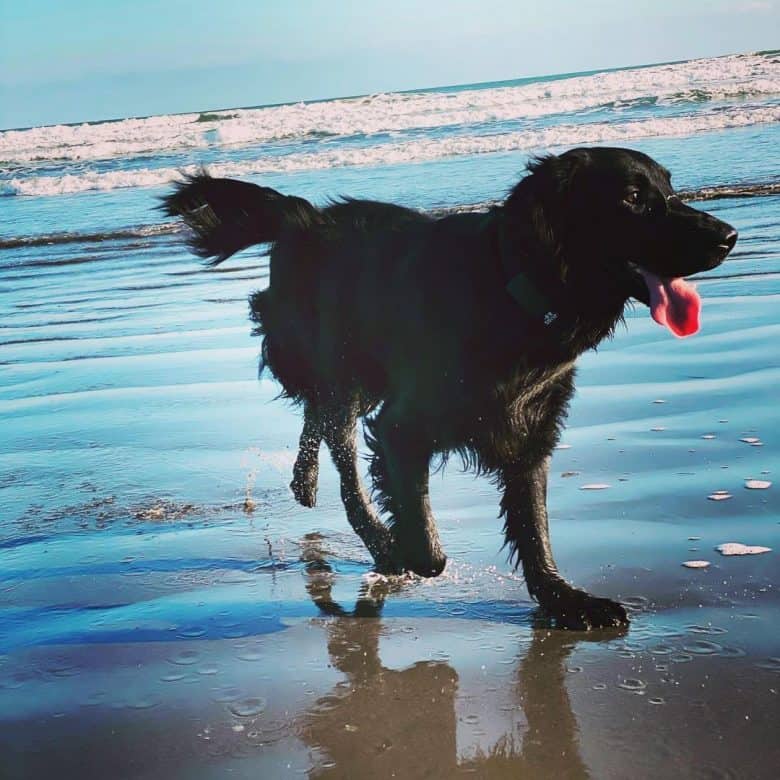
Puppies and young dogs should not run; it can be hard on their joints. Once they are adults, they are excellent running and jogging partners.
Feeding Your Flat-Coated Retriever
Flat-Coated Retrievers don’t have any breed-specific nutrient requirements or concerns. This high-energy canine will need quality food with sufficient protein and fat to keep them active and healthy.

Flat-Coated Retriever’s Health
Generally, the breed doesn’t have many health problems, but Flat-Coated Retrievers have a devastating predisposition to cancer.
Although there aren’t yet genetic tests to know if an individual dog is at risk, reputable breeders are working hard to choose healthy, long-lived canines to continue their lines.
Responsible breeders will test their potential breeding stock before deciding on a pairing. The testing requirements for Flat-Coated Retrievers include:
- Eye examination by a Board-Certified Veterinary Ophthalmologist to screen for Glaucoma, PRA, and Cataracts
- Patellar exam by a veterinarian to screen for Patellar Luxation
- Hip radiographs to screen for Hip Dysplasia
Once all of the recommended tests are complete and submitted, your dog will receive a CHIC number.
When looking for the breeder for your future Flat-Coated Retriever puppy, you can check to ensure their breeding dogs have had testing done and view the results.
Eye Concerns
-
Glaucoma
Glaucoma occurs when the pressure within the eyeball is above the normal limit. Glaucoma can be painful, and there is no effective treatment. The outcome is usually total blindness.
Flat-Coated Retrievers have a predisposition to inherited primary Glaucoma. There are estimates that it’ll affect one of every 100 Flat-Coats.
In hereditary primary Glaucoma, the obstruction to proper fluid draining results from improper development of the pectinate ligament.
This ligament should allow fluid to drain from the anterior eye chamber. Experts call pectinate ligament that hasn’t developed right “pectinate ligament dysplasia” or PLD.
You can detect this abnormality via a board-certified veterinary ophthalmologist before there are any other clinical signs of Glaucoma. This knowledge can help the breeder make responsible decisions when planning litters.
-
Progressive Retinal Atrophy (PRA)
PRA is an inherited condition that may lead to blindness. Rare in Flat-Coats, the estimates are that it may affect approximately 1% of the breed. At this time, there is not a genetic test for PRA in Flat-Coats.
-
Cataracts
Cataracts are an opacity within the eye’s lens. Flat-Coats are prone to hereditary cataracts. An examination by a specialist can determine whether a dog has cataracts and whether they are an inheritable type or not.
-
Entropion and Ectropian
During the eye exam, the specialist will also determine whether the Flat-Coat is either entropic or ectropic. Entropion is eyelids that turn in; this can cause abrasions as the eyelashes are now rubbing against the eyes.
Ectropion is eyelids turning out, putting the eyes at risk as they aren’t protected. A dog with entropion or ectropion requires surgical correction.
Joint Concerns
-
Patellar Luxation
In patellar luxation, the patellas, or kneecap, luxates or pops out of place. Vets should examine potential breeding dogs and clear them of any luxation before you make decisions.
The exam is a physical manipulation of the patella. The dog is awake, and the exam is not painful.
-
Hip Dysplasia
It is a hip joint with abnormal development, causing an improper fit between the ball of the hip and the joint pocket. The cartilage will break down over time, and arthritis will develop.
The dog will be in pain and have a limited range of movement. It would be best if you screened potential breeding dogs for this problem before making any decisions.
Vets screen dogs by x-ray. However, dogs with hip dysplasia may not show any symptoms when they are young. Radiographs allow experts to evaluate hip development and formation.
Cancers
The incidence of cancer in Flat-Coated Retrievers is high compared to other breeds.
One long-running Cambridge University study determined that half of all Flat-Coats will be diagnosed with cancer by age eight.
Although there aren’t yet tests or screenings that’ll allow a breeder to know which dog might be more likely to get cancer, there are trends within family lines.
-
Malignant Histiocytosis
Uncommon in many breeds, Malignant Histiocytosis is over-represented in Flat-Coated Retrievers.
It’s aggressive cancer that involves abnormal accumulation of histiocytes (a type of white blood cell). It’s typical for it to impact multiple sites at the same time.
Symptoms include poor appetite, weight loss, and lethargy. This aggressive cancer usually results in death within weeks or months.
-
Lymphosarcoma
Lymphosarcoma (or Lymphoma) is a cancerous disease of lymphocytes (a type of white blood cell that originates in lymph nodes and bone marrow).
This cancer is capable of spreading throughout the body. The most common clinical sign is the enlargement of the lymph nodes.
Without treatment, dogs will live an average of 30 days. With treatment, your canine can achieve remission of up to two years. Survival beyond two years is unlikely, even with treatment.
-
Hemangiosarcoma
Hemangiosarcoma is a malignant tumor that originates from blood vessels. The most common area of occurrence is the spleen.
These tumors are metastatic (prone to spreading). Affected dogs may develop further tumors within six months of the initial diagnosis. The most common area metastasized to is the brain.
Treatment may include surgical removal of the primary tumor, if possible, followed by chemotherapy. The long-term prognosis is poor.
Even with all available treatment options, less than 10% of dogs will survive a year or longer.
-
Osteosarcoma
Osteosarcoma is the most common primary bone tumor in dogs. The first clinical signs may be lameness.
When it comes to the standard treatment, it may include amputation of the affected leg. Chemotherapy may start after surgery.
Prognosis is better using a combination of surgery and chemotherapy. If cancer has already spread to the lungs, the prognosis will be poor.
Other Health Concerns
-
Gastric Dilatation Volvulus (Bloat)
Gastric dilatation-volvulus (GDV) is a life-threatening emergency. The start is an accumulation of air in the stomach, which causes the stomach to swell. The dog is at risk of progressing to a rotated stomach, called a torsion.
Large-breed dogs with deep, narrow chests (like Flat-Coated Retrievers) are at a higher risk. This aspect is a real medical emergency, and time is critical.
Even with immediate treatment, the fatality rate of bloat is still approximately 30%.
-
Epilepsy
Flat-Coats are at a higher risk for primary or idiopathic epilepsy. There is no genetic test for epilepsy. Most affected dogs can be well managed and live normal lives.
The life expectancy of a Flat-Coated Retriever is 8 to 10 years. This lower-than-average lifespan is a result of the high incidence of cancer in the breed.
A long-lived Flat-Coat is so rare that there is currently a study looking at any Flattie over 11 years of age.
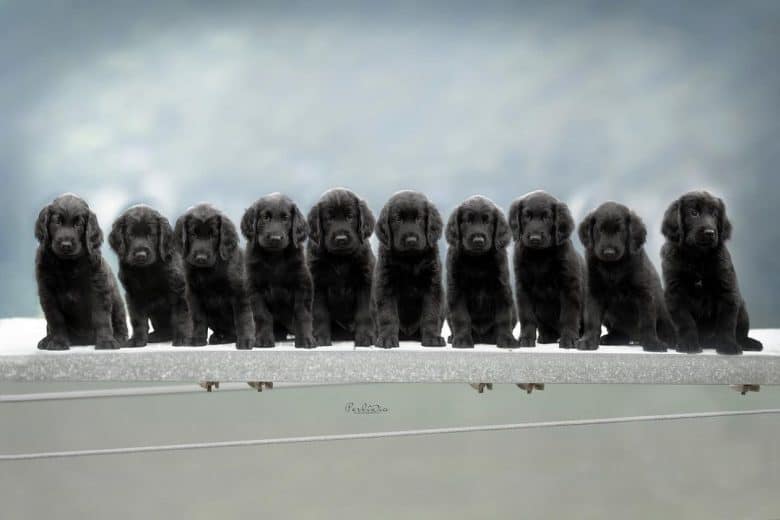
How Much Does the Flat-Coated Retriever Puppy Cost?
If you feel like you’re ready to buy a Flat-Coated Retriever puppy, the average price is around $1,500 to $3,000. But if you want one from champion lines or superior pedigree, expect the cost to start at $1,700.
The amount will depend on different factors like the breeder’s location and popularity, the lineage, and the available puppies.
No one wants to pay this much and just be disappointed by bringing home an unhealthy dog. To avoid being heartbroken, steer clear from buying a pup from pet stores, puppy mills, and backyard breeders.
Look for responsible puppy sellers that abide by the Flat-Coated Retriever Society of America (FCRSA) code of ethics, test their breeding stock to ensure no genetic diseases will be passed on to the litter and provides all the important documents related to the parents and the pup you’re hoping to purchase.
You should also prepare a questionnaire that you can discuss with the breeder before signing any contract.
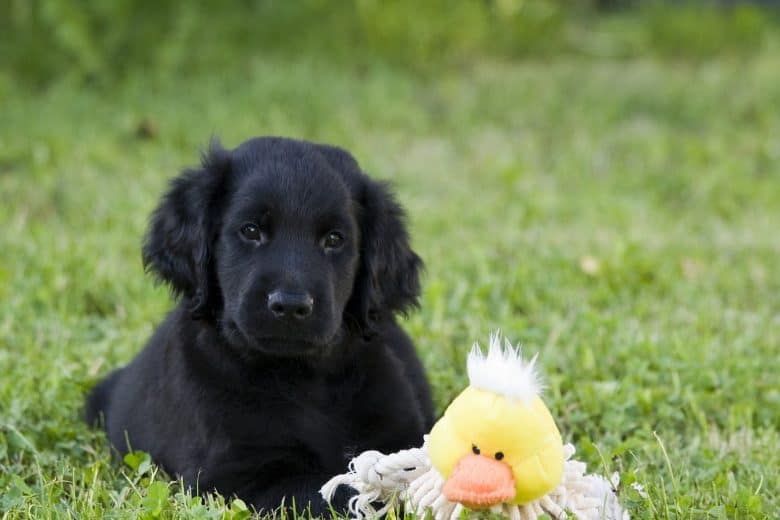
Flat-Coated Retriever Breeders
It’s quite easy to find Flat-Coated Retriever puppies for sale online, but it’s best that you start with the breed’s national club and the AKC’s Marketplace.
But we also tried to look for other kennels offering beautiful Flattie pups for you to check out:
- Liberty Flat-Coated Retrievers (South Carolina)
- Heirborn Kennels (Saint Joseph, MN)
- Dare Kennel (Blue Ridge Mountains)
If you’re mostly on Facebook, take a look at Northern Lights Flat-Coated Retrievers’ page. They bred the Flattie that won Best of Breed in Westminster 2020.
Rescuing a Flat Coated Retriever dog
And of course, we highly recommend adopting a Flat-Coated Retriever. There are many reasons why dogs end up in shelters, but mostly it’s because previous owners aren’t aware of what they’re getting themselves into.
Aside from saving a fur angel’s life, you’ll also be able to save a few bucks because the cost to adopt is cheaper – around $300. This option is also perfect for those who don’t want a puppy anymore.
Older dogs from rescue sites are already house trained, and you can easily find out about their health and temperament.
In case you want to rescue a Flat-Coat, another retriever, or even a Flattie mixed breed, browse these websites:
- Fetchin’ Retrievers Rescue (Los Angeles, CA)
- Retriever Rescue of Colorado (Evergreen, CO)
- Flatcoated Retriever Society
Rescue Shelter lets you choose your state within the United States to narrow down your search for Flat-Coated Retrievers to adopt.
Flat-Coated Retriever Vs. Golden Retriever Vs. Labrador Retriever
Many of the retrievers likely share a common ancestor in the Tweed Water Spaniel. Today, the Flat-Coat, Labrador, and Golden are different breeds.
Flat-Coated Retrievers come in liver and black, with Golden Retrievers in various shades of gold, from near-white to deep red. Labrador Retrievers are available in black, yellow, and chocolate.
The Flat-Coated Retriever is a lighter dog than the Golden or Labrador Retriever. Height is similar for all three.
The Flattie’s coat lies flat against their body, while the Golden has wavy fur with more undercoat, and the Labrador is a short-coated breed.
The Flat-Coat’s head is much more refined and narrow than the Golden or Lab’s broad skull.
All three are biddable dogs with a similar energy level. They’re famous for their love of children, make great family pets, and energetic companions.
All have a reputation for their working ability, although many more Golden Retrievers are pets than hunting dogs these days.
Curious about Flat-Coated Retriever Mixes?
There have been some intentional mixes created using the Flat-Coated Retriever.
Chatham Hill Retriever

The Chatham Hill Retriever is a mix of a Flat-Coat and a Cocker Spaniel. Although the Cocker Spaniel has a legacy as a gundog, they rarely hunt today. The Chatham Hill Retriever would be unlikely to excel at work.
The dense, profuse coat of the Cocker Spaniel is much different than the moderate Flattie coat. The Chatham Hill Retriever may end up with much more fur, requiring more grooming.
Both the Flat-Coat and the Cocker are high energy breeds. The Chatham Hill Retriever is likely to need significant exercise.
Aussie-Flat (Flat-Coated Retriever Australian Shepherd Mix)

The Aussie-Flat is a mix between a Flat-Coat and an Australian Shepherd. The purpose is to create a guide dog candidate.
At this time, no guide dog programs are working with this mix.
The dense, double coat of the Australian Shepherd is more extensive than the Flattie’s single coat. The resulting mix could end up with a profuse coat requiring considerable grooming.
Both of these breeds have a high amount of energy. The Aussie-Flat will likely need substantial exercise.
Who Should Get a Flat-Coated Retriever dog?
The Flat-Coated Retriever is a wonderful, sweet, intelligent dog. They adore children and are excellent family dogs. They are eager to join you on any adventure and can still excel at their original gundog purpose.
Their coat is low maintenance and manageable at home. They are high energy and need daily exercise, but are very trainable and biddable.
Bred for endurance, they won’t be happy with a stroll around the block every evening. Designed to work alongside their people, they won’t thrive being alone most of the time.
They excel at many sports and events and can be a great first show or sport dog. With proper exercise and training, they can be a wonderful dog for a first-time owner.
Do you have a Flat-Coated Retriever? Or are you thinking of having one join your family? We would love to hear from you.
Reference
- https://www.ruffwoodlabs.com/single-post/2018/12/03/Your-Labs-Ancestor-the-St-Johns-Water-Dog
- https://commons.wikimedia.org/wiki/File:Flat-Coated_Retriever_in_Tallinn.JPG
- https://images.akc.org/pdf/breeds/standards/FlatCoatedRetriever.pdf
- https://www.ofa.org/recommended-tests?breed=FR
- https://www.ofa.org/advanced-search?search=advanced
